
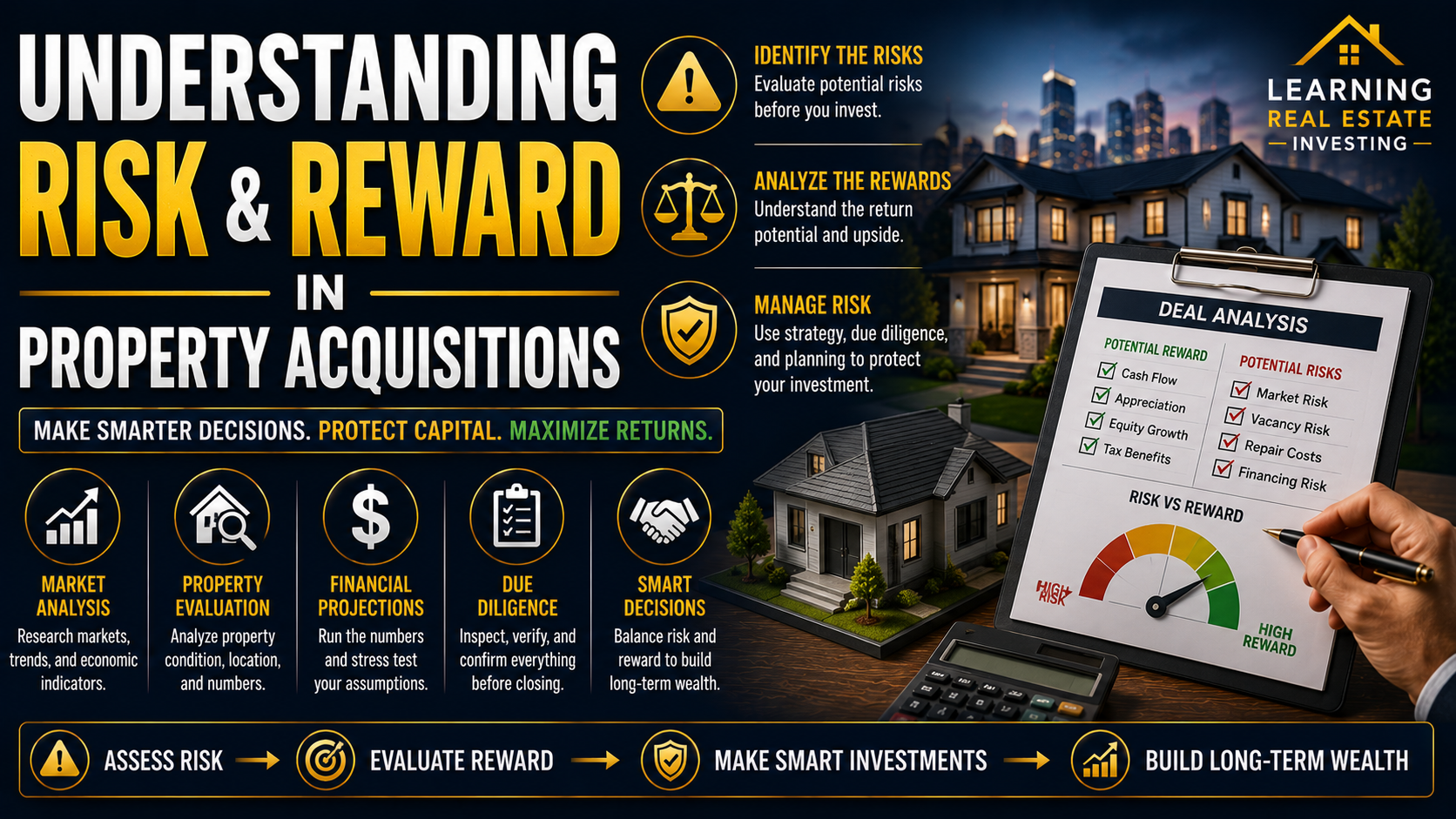
Understanding Risk and Reward in Property Acquisitions in 2026
Every real estate deal involves risk. The key is not avoiding risk entirely—it’s understanding how to measure it, manage it, and ensure the potential reward justifies the investment.
Successful Investors Calculate Risk Before They Chase Rewards
The best investors do not gamble. They analyze opportunities, evaluate downside scenarios, and make informed decisions based on facts rather than emotions.
Why Risk Assessment Matters
Many beginner investors focus exclusively on potential profits while ignoring potential problems.
Experienced investors understand that protecting capital is often more important than chasing the highest returns.
Every acquisition should be evaluated through both a risk lens and a reward lens.
Simple Investing Principle
Never risk a dollar without understanding how you plan to protect it.
What Is Risk in Real Estate?
Risk refers to the possibility that something will negatively impact your investment.
Common real estate risks include:
- Overpaying for a property
- Unexpected repair costs
- Vacancy issues
- Market declines
- Interest rate increases
- Tenant problems
- Financing challenges
- Economic downturns
Not all risks can be eliminated, but many can be reduced through proper due diligence.
What Is Reward in Real Estate?
Reward refers to the potential benefits an investor expects to receive.
Common rewards include:
- Monthly cash flow
- Property appreciation
- Tax advantages
- Equity growth
- Loan paydown
- Portfolio expansion
The goal is to find opportunities where potential rewards significantly outweigh potential risks.
Risk Factor #1: Buying at the Wrong Price
The easiest way to create risk is by overpaying.
Smart investors analyze:
- Comparable sales
- ARV (After Repair Value)
- Rental income potential
- Repair estimates
- Local market conditions
Many profitable deals are created at the purchase stage.
Risk Factor #2: Underestimating Repairs
Unexpected repairs can destroy projected profits.
Always inspect properties thoroughly and build contingency funds into your budget.
Investor Warning
One overlooked foundation issue, roof replacement, or HVAC failure can dramatically change the economics of a deal.
Risk Factor #3: Market Conditions
Even strong properties can struggle in weak markets.
Analyze:
- Population growth
- Job growth
- Housing inventory
- Rental demand
- Economic trends
- Local development projects
Strong markets often help reduce investment risk.
🏠 What Type of Real Estate Investor Are You?
Different strategies carry different levels of risk. Discover whether wholesaling, rentals, flipping, or BRRRR investing aligns with your goals.
Risk Factor #4: Financing Risk
Leverage can increase returns, but it also increases risk.
Before acquiring a property, understand:
- Interest rates
- Loan terms
- Monthly payments
- Cash reserves
- Debt-service coverage
Properties should be able to support financing obligations even during challenging periods.
Reward Factor #1: Cash Flow
Positive cash flow provides ongoing income and helps investors weather market fluctuations.
Properties that consistently produce income often offer greater financial stability.
Reward Factor #2: Appreciation
Property values may increase over time, creating additional wealth.
Investors often target growing markets where appreciation potential appears favorable.
Reward Factor #3: Equity Growth
Every mortgage payment can help build equity.
As loan balances decrease and property values rise, ownership value often increases.
How Smart Investors Balance Risk and Reward
- Analyze every deal carefully
- Use conservative projections
- Maintain cash reserves
- Diversify investments
- Understand local markets
- Inspect properties thoroughly
- Plan multiple exit strategies
The goal is not finding risk-free deals. The goal is finding deals where the reward justifies the risk.
The Importance of Due Diligence
Due diligence is one of the most effective risk management tools available.
Before closing on any acquisition, review:
- Property condition
- Title history
- Comparable sales
- Financial projections
- Local market data
- Rental demand
Good due diligence often prevents expensive surprises.
📖 Download the FREE Chapter
Learn how successful investors evaluate deals, analyze risk, calculate profits, and make smarter real estate investment decisions.
Final Thoughts
Every investment involves uncertainty.
The difference between successful investors and struggling investors is often their ability to evaluate risk objectively and pursue opportunities where the reward potential is compelling.
When you understand both sides of the equation, you can make more confident and informed acquisition decisions.
🚀 Ready to Analyze Deals Like a Professional?
The Real Estate Investing Blueprint teaches you how to evaluate risk, analyze deals, estimate repairs, understand market trends, and build wealth through smarter investments.