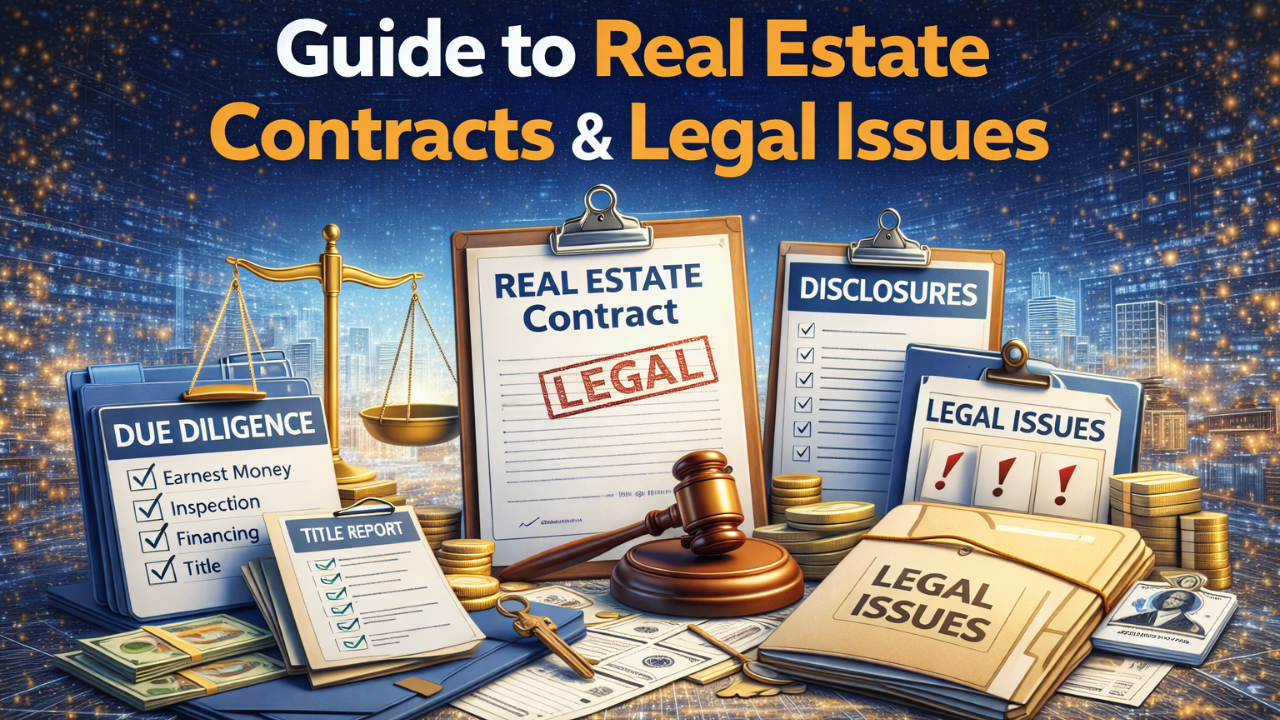
Guide to Real Estate Contracts and Legal Issues
The numbers can look perfect, the neighborhood can look great, and the seller can sound honest—
but the contract is what controls the outcome.
If you don’t understand what you’re signing, you’re not investing. You’re gambling.
This guide breaks down the key clauses investors must understand,
common legal issues that can derail deals,
and the due diligence steps that protect your money.
If you want a step-by-step investing foundation (checklists, deal analysis, systems),
start here:
LearningRealEstateInvesting.com
.
Why Contracts Matter More Than the Deal “Feeling Right”
Investors get hurt when they rely on assumptions:
“The title will be fine.” “The seller will handle it.” “The tenant will move out.”
Contracts remove assumptions and define responsibilities, deadlines, and remedies.
A strong contract creates leverage. A weak contract creates liability.
Key Contract Clauses Every Investor Should Understand
1) Purchase Price, Earnest Money, and Deposits
The contract should clearly state the purchase price, earnest money amount, where it will be held (often escrow),
and what conditions allow you to get it refunded.
If you don’t understand how you can lose your earnest money, stop and clarify before signing.
2) Inspection Contingency
Inspection contingencies give you time to verify condition before committing fully.
This is one of the most important protections for investors—especially on distressed properties.
The contract should spell out inspection timelines and what rights you have to renegotiate or cancel.
If you’re actively buying distressed deals, also review your process guide at
LearningRealEstateInvesting.com
so your inspection timeline matches your rehab evaluation workflow.
3) Financing Contingency
If you’re using a loan, your financing contingency protects you if funding fails.
Investors should understand deadlines for loan approval and documentation requirements.
Missing a financing deadline can put your earnest money at risk.
4) Closing Date, Possession, and Extensions
Closing dates drive everything—lock expirations, contractor schedules, and seller expectations.
The contract should also specify when you get possession: at closing, after closing, or later.
If the seller wants post-closing occupancy, make sure there’s a written agreement with terms and penalties.
5) Disclosures and Property Condition
Disclosures vary by state, but the principle stays the same:
you want transparency about known defects, prior damage, and major system issues.
Do not confuse disclosures with inspections.
Disclosures are what the seller knows; inspections verify what’s true.
6) Title, Survey, and Liens
Clear title is non-negotiable.
Title issues can include unpaid taxes, mechanics liens, boundary disputes, easements, and ownership defects.
Contracts typically address who pays for title insurance, what happens if defects are found,
and how long each party has to cure issues.
Common Legal Issues That Can Derail a Deal
Title Defects and Clouded Ownership
A property can look fine but still carry legal baggage.
Title defects can delay closing or kill a deal outright.
Always insist on a proper title search and understand your rights if defects appear.
Zoning, Permits, and Use Restrictions
Investors get burned when they assume a property can be used the way they want.
Zoning restrictions, HOA rules, and permit requirements can block plans like adding units,
short-term rentals, or converting a garage.
Tenant Rights and Occupancy Issues
Buying a property with tenants (or occupants) requires extra caution.
Leases, local tenant protection laws, and eviction timelines can all affect your exit strategy.
If you’re inheriting tenants, review leases and rent rolls before you remove contingencies.
Environmental and Property Condition Liability
Environmental concerns aren’t limited to commercial properties.
Mold, asbestos, underground tanks, and other hazards can create major liability.
This is another reason inspection contingencies matter.
Practical Due Diligence Steps Investors Should Follow
- Review the contract line-by-line: never rely on “standard” language
- Confirm your contingencies: inspection, financing, appraisal (if needed)
- Order title work early: don’t wait until the last week
- Verify property status: occupancy, leases, unpaid utilities, code issues
- Document everything: communication, amendments, repairs, credits
Want a simple checklist you can reuse on every purchase?
Grab the investor contract checklist at
LearningRealEstateInvesting.com
.
When to Hire an Attorney (And Why It’s Usually Worth It)
If you’re doing anything beyond a straightforward retail purchase,
legal review is cheap compared to the cost of a mistake.
Investors often involve attorneys for:
- Creative financing or seller financing agreements
- Subject-to or lease-option structures
- Tenant-occupied properties with complex leases
- Probate/estate transactions
- Title or boundary disputes
For broader investor mindset, business strategy, and long-term wealth perspective,
visit
MauriceReese.com
.
Conclusion
Contracts aren’t paperwork—they’re protection.
Read every word, understand every deadline, and never assume anything is “fine” without verification.
One overlooked clause can erase a year of profits.
Investor Tip:
Get my real estate contract checklist and legal due diligence guides at
LearningRealEstateInvesting.com
.
Leave a Reply