The Ultimate Guide to Real Estate CRM Systems for Investors in 2026
Real estate investing is a relationship-driven business. Deals rarely happen after one phone call. Instead, most opportunities develop through follow-ups, conversations, and long-term connections with sellers, buyers, and partners.
However, managing those relationships becomes difficult as your business grows.
For that reason, many successful investors rely on Customer Relationship Management (CRM) systems. These tools organize contacts, track leads, and automate follow-ups.
In 2026, CRM systems have become one of the most important technologies for real estate investors. Not only do they save time, but they also ensure no opportunity slips through the cracks.
This guide explains what real estate CRM systems are, why investors use them, and how they can help grow a profitable real estate business.
What Is a Real Estate CRM System?
A CRM system is software designed to organize and manage business relationships.
In real estate investing, a CRM tracks interactions with:
• Motivated sellers
• Potential buyers
• Real estate agents
• Contractors
• Private lenders
• Business partners
Instead of storing contact details across multiple spreadsheets or notebooks, a CRM centralizes everything in one location.
For example, when a seller calls about a property, the CRM records the conversation. Later, you can add notes, set reminders, and track follow-ups. As a result, the system helps you stay organized even when managing hundreds of leads.
Most importantly, CRMs help investors maintain consistent communication with potential deal sources.
Why Real Estate Investors Need a CRM in 2026
Real estate markets are competitive. Therefore, responding quickly to opportunities is critical.
Without a CRM, investors often lose track of leads. Emails get buried, phone numbers disappear, and follow-ups are forgotten.
A CRM solves these problems.
First, it stores every contact and conversation in one place. Second, it tracks the status of each lead. Third, it reminds you when it is time to follow up.
Because of these features, CRM systems help investors stay organized and maintain professional communication.
In addition, automation features can send follow-up messages automatically. As a result, investors can manage many leads at once without being overwhelmed.
Key Features of a Good Real Estate CRM
Not every CRM is designed for real estate investing. Therefore, it is important to choose software that supports your specific workflow.
Below are several features investors should look for when choosing a CRM.
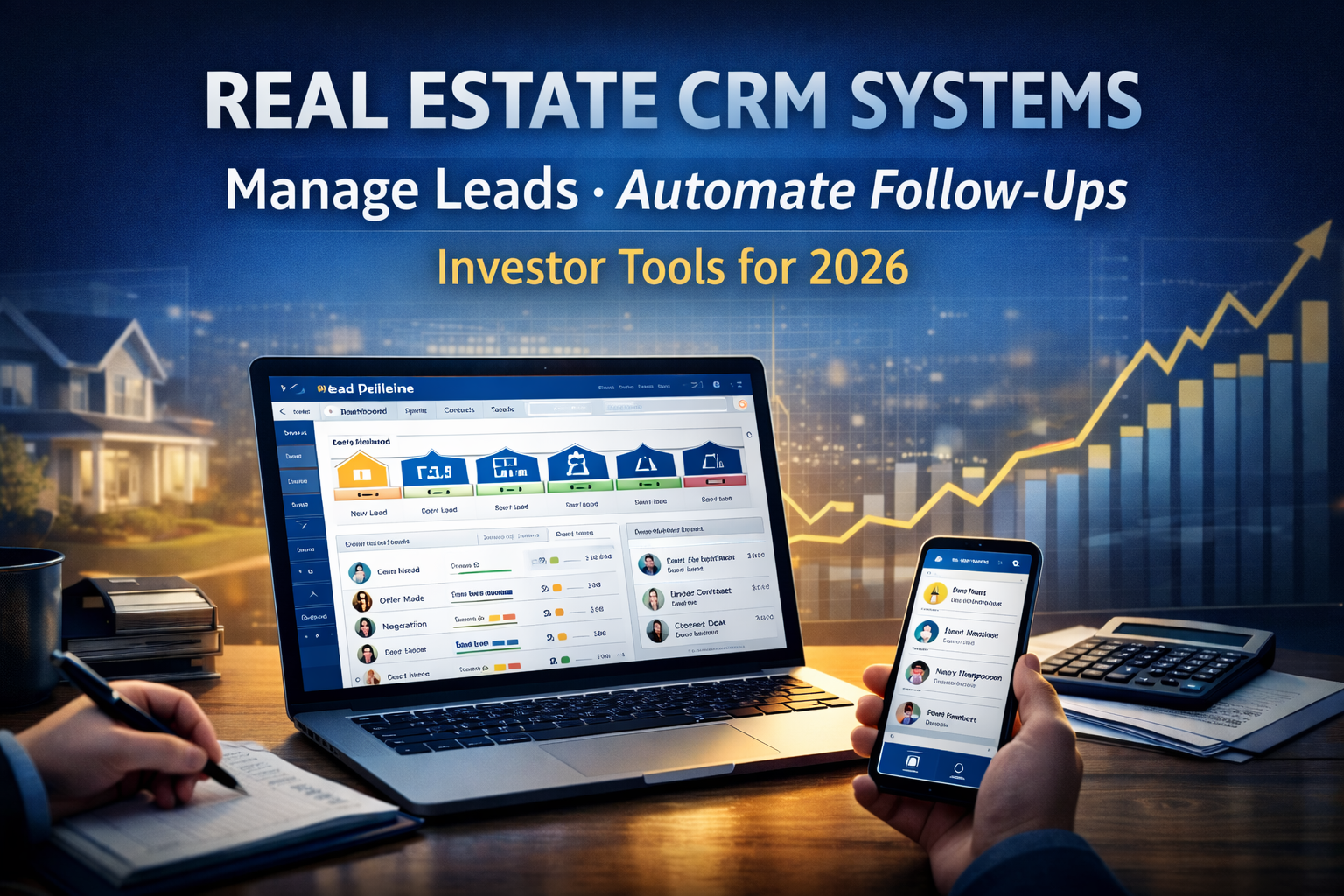
Lead Management
First, a strong CRM should organize incoming leads. For example, it may categorize them as:
• New leads
• Follow-up required
• Negotiation stage
• Under contract
• Closed deal
This system helps investors see exactly where each opportunity stands.
Automated Follow-Ups
Next, automation saves a significant amount of time.
Instead of manually sending emails or text messages, a CRM can schedule automatic communication sequences. Consequently, investors stay in contact with potential sellers without constant effort.
Contact Organization
Another important feature is contact management.
A CRM stores names, phone numbers, email addresses, and conversation notes. Additionally, it can track property details connected to each contact.
Over time, this database becomes extremely valuable.
Task Reminders
Furthermore, task reminders ensure nothing is forgotten.
For instance, you can schedule reminders to:
• Call a seller next week
• Send a contract
• Check property inspection results
• Follow up with buyers
Because of these reminders, investors maintain consistent deal flow.
How CRM Systems Improve Deal Flow
Consistent deal flow is the foundation of a successful real estate investing business.
However, deals rarely happen immediately. Often, sellers need time before deciding to sell.
For example, a homeowner may say they are “thinking about selling.” A few months later, that same person may become motivated.
Without proper follow-up, the opportunity disappears.
On the other hand, a CRM ensures regular communication.
First, it schedules follow-ups automatically. Next, it records every interaction with the seller. Finally, it reminds investors when to reconnect.
As a result, CRM users often close more deals simply because they follow up consistently.
How Investors Use CRM Systems in Daily Operations
Real estate investors rely on CRMs in several ways.
First, they use them to track incoming marketing leads. For instance, when someone fills out a property offer form, the information enters the CRM automatically.
Next, investors use the CRM to manage communication with sellers. Phone calls, emails, and text messages are logged in the system.
Additionally, CRMs help investors manage their buyer lists. When a property becomes available, the system can quickly notify interested buyers.
Finally, CRM dashboards provide a clear overview of the entire pipeline. Investors can see how many deals are active, how many leads require follow-up, and which opportunities are moving toward closing.
Common Mistakes Investors Make With CRM Systems
Although CRM software is powerful, many investors fail to use it effectively.
One common mistake is entering incomplete information. Without accurate notes, it becomes difficult to remember details about each lead.
Another mistake is ignoring follow-up reminders. The system works only if investors follow the process.
Some investors also attempt to use too many tools at once. Instead, it is better to keep systems simple.
Choose one CRM, learn it thoroughly, and build consistent workflows around it.
Over time, a well-organized CRM becomes one of the most valuable assets in your business.
The Future of Real Estate CRM Systems
Technology continues to reshape the real estate industry.
In 2026, CRM systems increasingly include advanced features such as:
• AI-powered lead scoring
• Predictive seller motivation analysis
• Automated marketing campaigns
• Integrated deal analysis tools
• Voice-to-note call recording
Because of these innovations, CRM systems are evolving from simple contact managers into full business management platforms.
Consequently, investors who adopt these tools early gain a significant advantage.
Final Thoughts
Real estate investing depends on relationships, organization, and consistent follow-up.
A CRM system helps investors manage all three.
Instead of relying on memory or scattered notes, successful investors use structured systems that track leads and automate communication.
Over time, this discipline leads to more deals, stronger relationships, and a scalable real estate investing business.
For that reason, CRM systems have become essential tools for serious investors in 2026.
Ready to Learn the Real Estate Investing System?
If you want to learn how investors find deals, analyze properties, and build long-term wealth through real estate, start here:
Learn the Real Estate Investing Blueprint
Discover the strategies real estate investors use to find opportunities, analyze deals, and build passive income through property investing.
Get the Real Estate Investing Blueprint →
Build skills. Build assets. Build financial freedom.
Leave a Reply