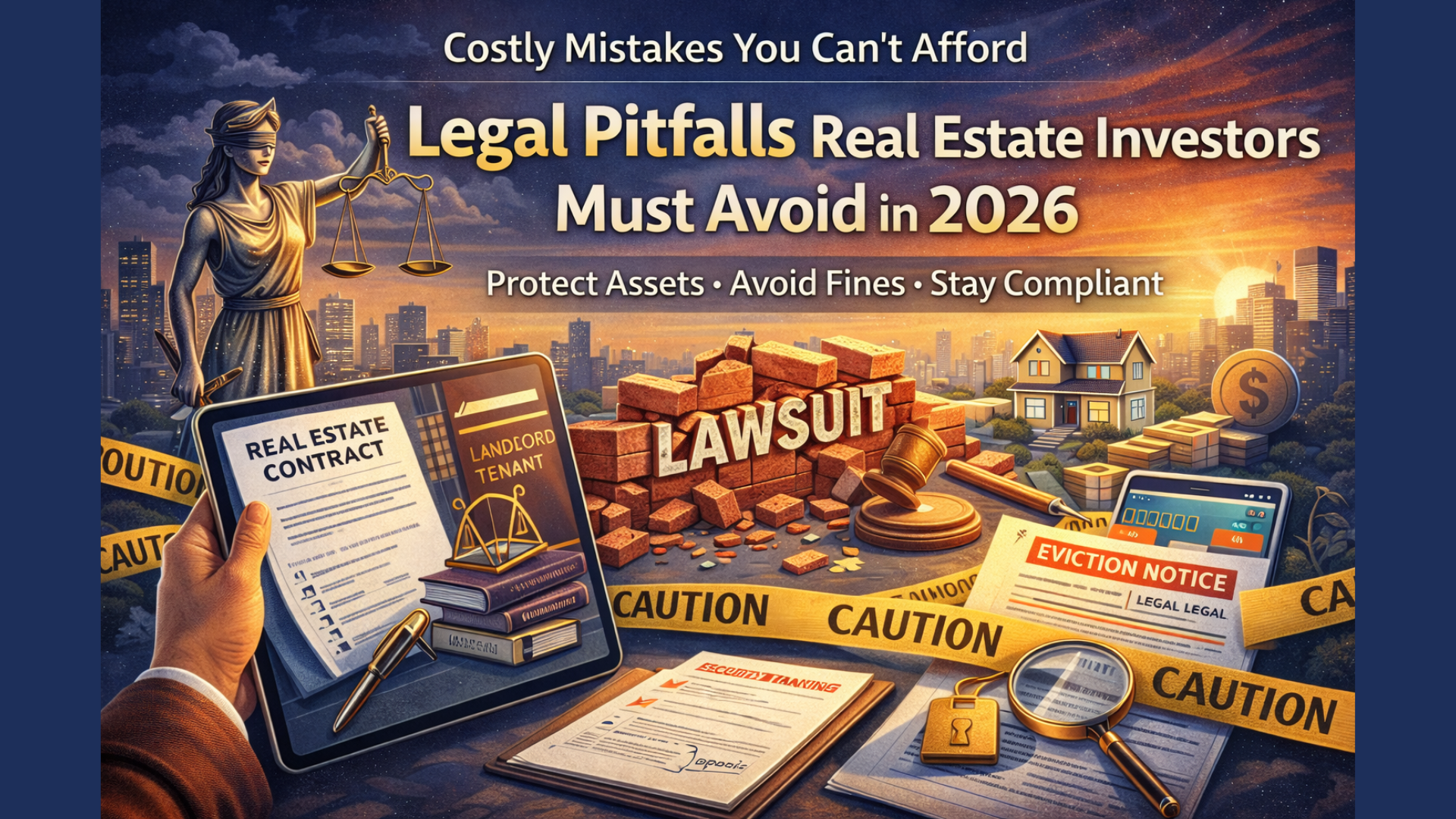
Legal Pitfalls Real Estate Investors Must Avoid in 2026
Real estate can build serious wealth. However, one legal mistake can destroy it just as fast.
In 2026, the rules are tighter. Laws are changing. At the same time, investors are moving quickly.
Because of this, smart investors focus on two things:
growth and protection.
If you ignore the legal side, you will eventually pay for it.
Why Legal Mistakes Are More Dangerous Today
First, understand this clearly.
Legal issues are not small problems. Instead, they are expensive problems.
For example:
A bad contract can kill a deal
A missed disclosure can trigger lawsuits
A tenant issue can lead to fines
As a result, one mistake can wipe out your profits.
Therefore, you must treat legal protection as part of your system—not an afterthought.
Pitfall #1: Using Weak or Generic Contracts
Many investors try to save time. So, they download contracts online and use them as-is.
That approach is risky.
Every deal is different. In addition, laws vary by state.
Because of this, smart investors:
Use state-specific contracts
Review every clause
Adjust terms when needed
Even one unclear sentence can create confusion later.
In real estate, clarity protects you.
Pitfall #2: Misunderstanding Deal Numbers
At first, this may not seem like a legal issue. However, it becomes one quickly.
If your numbers are wrong, you can run into disputes with:
Partners
Buyers
Lenders
For example, if rehab costs are underestimated, profit disappears. Then disagreements begin.
Because of this, smart investors always verify their numbers.
👉 Analyze Your Deals the Right Way
In addition, they double-check repair costs:
👉 Estimate Rehab Costs Accurately
Accurate numbers prevent legal problems before they start.
Pitfall #3: Not Using the Right Business Structure
Another common mistake is operating without protection.
If you buy properties in your personal name:
Your personal assets are exposed
Lawsuits can affect your finances
Instead, smart investors use:
LLCs
Proper insurance
Structured ownership
This creates separation between you and your business.
In simple terms, structure equals protection.
Pitfall #4: Violating Fair Housing Laws
Fair housing laws are strict. However, many investors still overlook them.
Even small mistakes can cause problems.
For example:
Poorly written listings
Unequal screening
Inconsistent policies
Because of this, you must stay consistent.
Always:
Treat applicants the same
Follow the same criteria
Document decisions
Consistency reduces risk.
Pitfall #5: Poor Tenant Screening
Bad tenants lead to bigger problems.
For instance:
Missed payments
Property damage
Evictions
However, the issue usually starts at screening.
Smart investors follow a clear process:
Verify income
Check credit
Review background
Apply the same rules
When you skip steps, problems increase.
Pitfall #6: Rushing Deals Without a Lead System
This is where many investors make costly mistakes.
When deals are scarce, people rush. As a result, they:
Skip due diligence
Miss key details
Accept bad terms
Instead, smart investors build systems.
👉 Build a Lead-Generating Website
And if they want consistency:
👉 Learn to Generate Deals Monthly
When deals come to you, you make better decisions.
Pitfall #7: Mismanaging Security Deposits
Security deposits are simple—but highly regulated.
If handled incorrectly, you can face:
Legal disputes
Penalties
Tenant complaints
Therefore, you must:
Follow state rules
Document property condition
Return deposits on time
Small details matter here.
Pitfall #8: Ignoring Local Laws
Real estate laws are not the same everywhere.
They change by:
State
City
County
Because of this, you must stay informed.
For example:
Rental rules
Eviction timelines
Short-term rental laws
Ignoring local laws can stop your business fast.
Pitfall #9: Not Documenting Everything
Documentation protects you.
Without it, you have no proof.
Smart investors document:
Agreements
Repairs
Payments
Communication
This creates a clear record.
In legal situations, records win.
Pitfall #10: Lack of Systems
Finally, most legal issues come from disorganization.
When systems are missing:
Mistakes increase
Steps are skipped
Problems multiply
Instead, build systems for:
Deal analysis
Lead tracking
Communication
Marketing
Systems reduce errors. Fewer errors mean fewer legal issues.
Stay Educated and Stay Protected
Laws change over time. Therefore, you must stay updated.
Smart investors keep learning. They adjust as needed.
If you are building your foundation:
Knowledge reduces risk.
🚀 Ready to Build a Protected Real Estate Business?
Final Thoughts
Legal pitfalls are predictable. However, they are also avoidable.
Smart investors:
Stay informed
Follow systems
Document everything
Protect their assets
In the end, making money is only half the game.
Keeping it is what matters.
Leave a Reply