
Assignment Contract vs. Double Closing: Which Wholesale Strategy Is Right for You?
Quick Answer
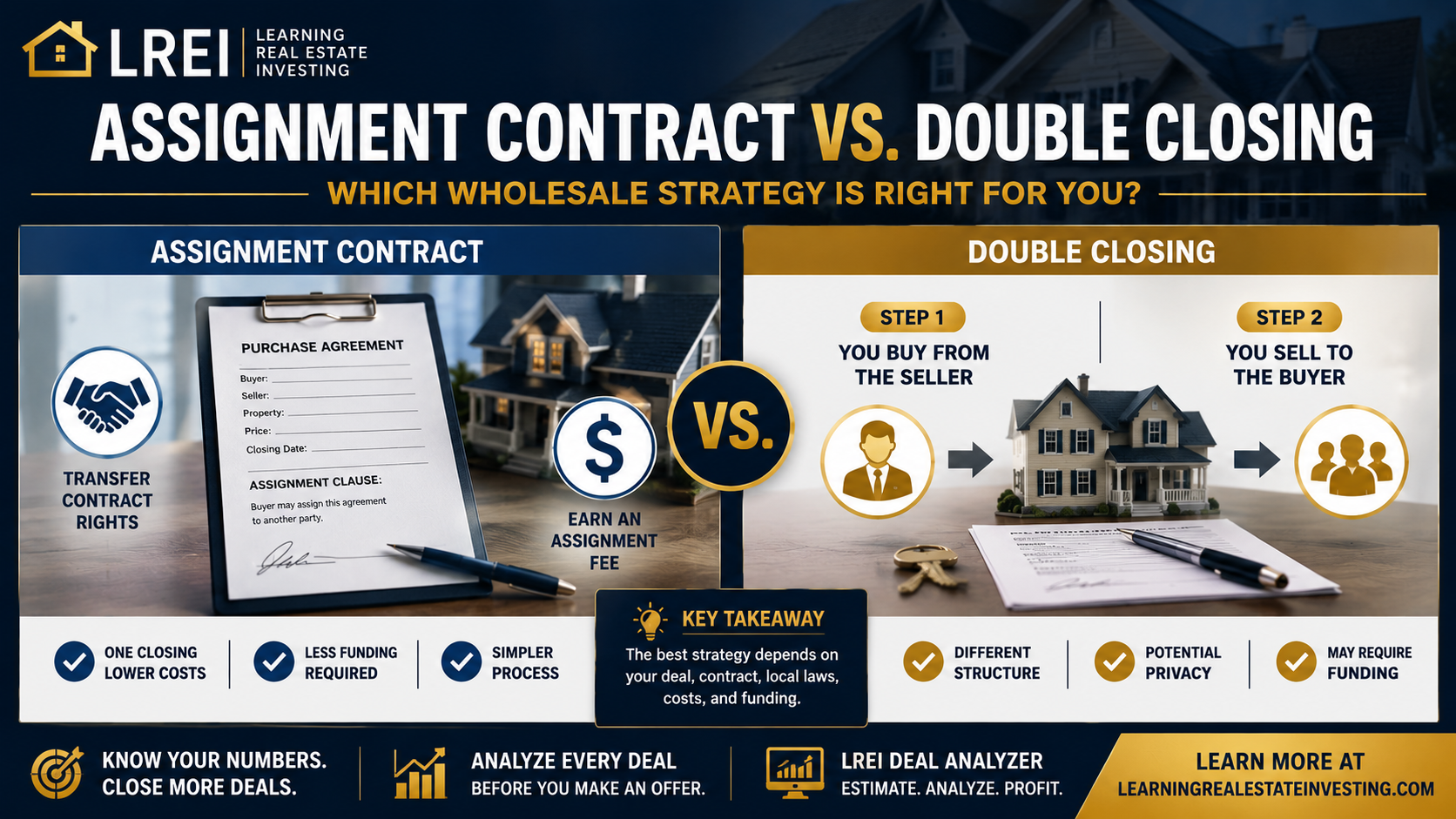
An assignment contract transfers your contractual rights to another buyer, while a double closing involves actually purchasing the property and then reselling it in a second transaction. Assignments are generally simpler and less expensive, while double closings can provide more flexibility in certain transactions. The right choice depends on your contract, local law, deal economics, funding, and the expectations of the seller and end buyer.
Key Takeaways
- An assignment transfers contractual rights without the wholesaler buying the property first.
- A double closing creates two separate real estate transactions.
- Assignments generally involve fewer closing costs.
- Double closings may require transactional or short-term funding.
- Neither strategy should be used without understanding your contract and local requirements.
- The quality of the deal matters more than the exit strategy.
Table of Contents
Assignment contracts and double closings are two of the most common exit strategies used in real estate wholesaling.
Both can potentially allow a wholesaler to profit from finding a discounted property and connecting that opportunity with another investor, but the legal and financial structure of the two transactions is very different.
Understanding those differences before putting a property under contract can help you avoid unnecessary costs, delays, and confusion at closing.
Do not wait until a buyer is ready to close before deciding how the transaction will be structured. Understand your likely exit strategy before you sign the original purchase agreement.
What Is an Assignment Contract?
An assignment occurs when the original buyer transfers some or all of their contractual rights under a purchase agreement to another buyer, assuming assignment is permitted by the contract and applicable law.
In a typical wholesale transaction, the wholesaler signs a purchase agreement with the seller and later assigns their position in that contract to an end buyer.
Simple Assignment Example
| Transaction Item | Example Amount |
|---|---|
| Seller Contract Price | $150,000 |
| End Buyer Price | $160,000 |
| Potential Assignment Fee | $10,000 |
The end buyer takes the assigned contractual position and proceeds toward closing according to the contract and assignment documents.
Assignments are popular because the wholesaler generally does not need to purchase and finance the property before transferring the opportunity to the end buyer.
What Is a Double Closing?
A double closing involves two separate transactions.
- The wholesaler purchases the property from the original seller.
- The wholesaler then sells the property to the end buyer.
The transactions may happen on the same day or within a short period, depending on the deal and closing process.
Because the wholesaler actually becomes the buyer in the first transaction, double closings generally involve additional documentation, closing expenses, and funding considerations.
A double closing is not simply an assignment with extra paperwork. The wholesaler is participating in two separate real estate transactions and may temporarily take ownership of the property.
Assignment Contract vs. Double Closing
| Feature | Assignment Contract | Double Closing |
|---|---|---|
| Wholesaler Purchases Property? | Usually No | Yes |
| Number of Closings | One | Two |
| How Wholesaler Gets Paid | Assignment fee | Profit from resale |
| Funding Requirement | Usually Lower | Often Higher |
| Closing Costs | Usually Lower | Usually Higher |
| Complexity | Lower | Higher |
| Privacy of Wholesale Spread | Often More Visible | May Be Less Visible Depending on Transaction Documents |
Advantages of Assignment Contracts
Lower Capital Requirements
Because the wholesaler does not normally purchase the property first, an assignment may require substantially less capital.
Lower Transaction Costs
There is generally one property closing rather than two.
Simpler Structure
Assignments can be easier for beginners to understand when the contract clearly permits assignment and the closing team is familiar with wholesale transactions.
Potentially Faster
There are fewer moving pieces than a double closing.
An assignment is only useful if the underlying deal is attractive to the end buyer. A weak deal does not become profitable simply because it is assignable.
Advantages of Double Closings
Different Transaction Structure
Some transactions are better suited to a purchase-and-resale structure rather than an assignment.
Potentially Greater Privacy
Depending on the transaction and required disclosures, an end buyer may not see an assignment fee because the wholesaler’s profit comes from the resale spread.
Useful When Assignment Is Impractical
A double closing may be considered when assignment restrictions, buyer preferences, seller concerns, or transaction structure make a direct assignment unsuitable.
Before choosing either strategy, speak with the title company or closing attorney handling the transaction. Make sure they understand how you intend to structure the deal before closing day arrives.
Costs and Funding Differences
This is one of the biggest practical differences between the two strategies.
Assignment Costs
An assignment may involve:
- Earnest money
- Marketing costs
- Title or attorney fees
- Assignment-document preparation
- Business operating expenses
Double Closing Costs
A double closing may additionally involve:
- Two sets of closing costs
- Transactional funding fees
- Lender fees
- Wire fees
- Title costs
- Potential taxes or recording expenses depending on the jurisdiction
That means the wholesale spread must be large enough to justify the additional transaction costs.
Know Your Numbers Before Choosing Your Exit
Use the LREI Deal Analyzer to estimate ARV, repairs, profit, return on investment, and your maximum allowable offer before deciding how to structure the wholesale deal.
Which Strategy Is Better for Beginners?
For many beginners, assignments may be easier because they generally involve fewer transaction steps and lower capital requirements.
That does not mean assignments are automatically the correct choice.
Consider:
- Does the purchase agreement permit assignment?
- Does local law allow the transaction to be structured as planned?
- Does the seller understand the transaction?
- Does the end buyer accept assignments?
- How large is the wholesale spread?
- What are the closing costs?
- Is funding available for a double closing?
The right exit strategy should be selected because it fits the transaction—not because someone online said one method is always better.
Common Assignment and Double Closing Mistakes
Not Reading the Purchase Agreement
Never assume every purchase agreement can be assigned.
Ignoring Local Wholesaling Rules
Wholesaling laws, licensing requirements, disclosures, and marketing rules vary by jurisdiction.
Failing to Calculate Closing Costs
A double closing can look profitable until the additional costs are included.
Waiting Too Long to Select an Exit Strategy
Your closing professionals should understand the intended structure early in the process.
Marketing a Bad Deal
No exit strategy can rescue an overpriced property.
Do not hide behind complicated transaction structures to avoid communicating honestly with sellers, buyers, or closing professionals. Transparency and proper documentation protect everyone involved.
Assignment vs. Double Closing Checklist
- ✅ Analyze the property before contracting it.
- ✅ Confirm whether assignment is permitted.
- ✅ Understand local wholesaling requirements.
- ✅ Calculate the true wholesale spread.
- ✅ Estimate all closing and funding costs.
- ✅ Confirm your buyer is financially qualified.
- ✅ Discuss the structure with the closing professional.
- ✅ Have contracts reviewed by a qualified real estate attorney.
What Type of Real Estate Investor Are You?
Take the FREE investor quiz to discover the strategy that best matches your goals, capital, available time, and risk tolerance.
Real Estate Investing Resource Center
Use these tools and guides to understand wholesaling, analyze opportunities, and build your investing business.
📘 The Real Estate Investing Blueprint
Learn wholesaling, flipping, rentals, BRRRR, creative financing, and deal analysis.
📊 LREI Deal Analyzer
Analyze ARV, repairs, ROI, cash flow, and your maximum allowable offer.
📈 LREI Deal Analyzer 3.0
Use the advanced analyzer for wholesale, flip, rental, and BRRRR opportunities.
🚀 100K Blueprint
Create a focused roadmap for growing your real estate investing business.
🏘️ Flipster
Explore a platform designed to help investors locate off-market opportunities.
💬 LREI Action Lab
Access investor motivation, real estate quotes, and useful calculators.
Frequently Asked Questions
Is an assignment contract the same as a double closing?
No. An assignment transfers contractual rights, while a double closing involves two separate real estate transactions.
Which strategy costs more?
Double closings generally cost more because the wholesaler participates in two closings and may need short-term or transactional funding.
Can every purchase agreement be assigned?
No. Assignment rights depend on the contract and applicable law. Always review the agreement carefully.
Can a beginner use a double closing?
Yes, but double closings are generally more complex. Beginners should work with experienced closing professionals and understand the funding requirements before using this structure.
Do I need transactional funding?
Possibly. Some double closings require the wholesaler to fund the first purchase before receiving proceeds from the resale. Funding requirements depend on the transaction and closing process.
Which strategy is better?
Neither is automatically better. The right choice depends on your contract, local law, funding, costs, buyer and seller expectations, and the economics of the deal.
Ready to Learn How Wholesaling Really Works?
Download the FREE chapter of The Real Estate Investing Blueprint and learn how to find opportunities, analyze deals, negotiate with sellers, and build your real estate investing foundation.