
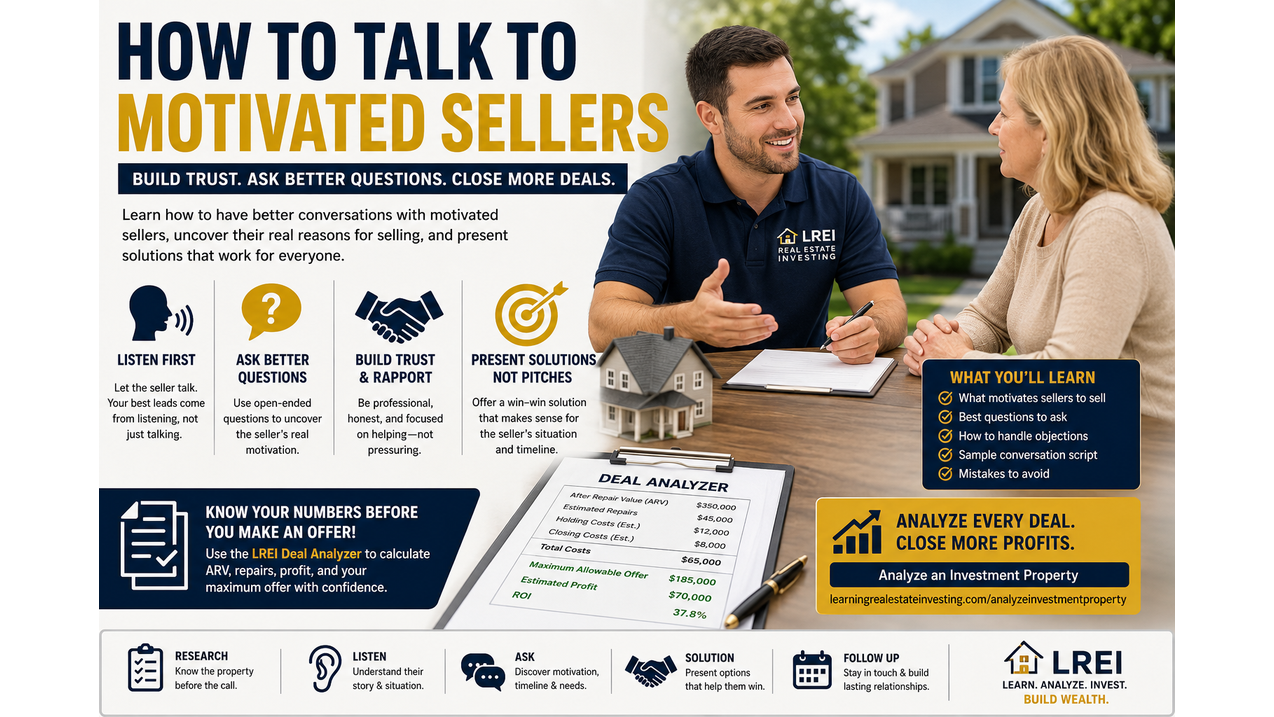
How to Talk to Motivated Sellers: A Beginner’s Guide to Building Trust and Closing More Deals
Quick Answer
Learning how to talk to motivated sellers is less about using a clever sales script and more about asking good questions, listening carefully, understanding the seller’s real problem, and determining whether your offer can provide a workable solution. The strongest investor conversations are professional, transparent, respectful, and focused on the seller’s priorities—not on pressuring someone into accepting a deal.
Key Takeaways
- Ask open-ended questions instead of immediately asking for the seller’s lowest price.
- Listen for motivation, timeline, property condition, and decision-makers.
- Do not assume every seller needs or wants a cash offer.
- Know your property numbers before discussing a serious offer.
- Follow-up is often as important as the first conversation.
- Professionalism and honesty build more trust than aggressive closing tactics.
Table of Contents
- What Is a Motivated Seller?
- Prepare Before the Conversation
- How to Build Rapport
- Questions to Ask Motivated Sellers
- How to Listen for Seller Motivation
- How to Discuss Price
- Handling Common Seller Objections
- Sample Motivated Seller Conversation
- How to Follow Up
- Common Beginner Mistakes
- Frequently Asked Questions
How to talk to motivated sellers is one of the most important skills a wholesaler or active real estate investor can develop. You can have great marketing, powerful software, and a large list of leads, but those leads will not turn into deals if you cannot have productive conversations with property owners.
The objective is not to manipulate a homeowner into selling below market value. Your job is to understand the property, identify the seller’s priorities, analyze what you can realistically offer, and determine whether there is a transaction that makes sense for both sides.
Do not approach motivated sellers thinking, “How do I close this person?” Ask instead, “What does this seller actually need, and is there a legitimate way I can help?” That mindset changes the entire conversation.
What Is a Motivated Seller?
A motivated seller is a property owner who has a meaningful reason for considering a sale and may value factors beyond obtaining the absolute highest possible price.
Examples may include:
- An inherited property the owner does not want to maintain
- A rental property with management problems
- A home requiring substantial repairs
- An upcoming relocation
- Financial pressure
- A vacant property
- A property the owner simply no longer wants
- A desire for a faster or more convenient sale
Do not assume someone’s motivation based on a mailing list or lead source. Ask the seller directly and let them describe the situation in their own words.
Prepare Before You Call a Motivated Seller
Preparation helps you sound confident without sounding rehearsed.
Before the conversation, gather whatever reliable property information is available to you.
- Property address
- Basic property characteristics
- Approximate market value
- Recent comparable sales
- Estimated rent if relevant
- Potential repair needs if known
- Your intended investing strategy
You do not need to know everything before the first conversation. The seller will often provide information you cannot see online.
Keep a simple seller lead sheet beside you during every conversation. Track property condition, motivation, asking price, timeline, mortgage or lien information when voluntarily provided and relevant, decision-makers, and the date of your next follow-up.
How to Build Rapport With Motivated Sellers
Rapport is not about pretending to be someone’s best friend. It is about demonstrating that you are listening, communicating clearly, and treating the homeowner with respect.
A simple opening can be enough:
This establishes expectations without making promises.
From there, let the seller speak.
Many inexperienced investors rush to prove how much they know. Sellers usually care more about whether you understand their situation and whether you will do what you say.
Questions to Ask Motivated Sellers
You do not need to interrogate the seller. Think of these as conversation prompts.
Questions About the Property
- Can you tell me a little about the property?
- How long have you owned it?
- What condition is it in today?
- Are there any major repairs you think it needs?
- Have you made any significant improvements recently?
- Is the property currently occupied or vacant?
Questions About Motivation
- What has you thinking about selling now?
- What would you like to accomplish by selling the property?
- Have you considered listing it with a real estate agent?
- What is most important to you about the sale?
Questions About Timeline
- When would you ideally like to have the property sold?
- Is there a particular date you’re working around?
- What happens if the property does not sell by then?
Questions About Price
- Do you have a price in mind?
- How did you arrive at that number?
- Have you received any other offers?
Questions About the Decision
- Is anyone else involved in deciding whether to sell?
- What would need to happen for you to feel comfortable moving forward?
Do not fire ten questions in a row. Ask one question, listen to the response, and let the answer guide your next question. The seller should feel like they are having a conversation—not completing an application.
How to Listen for Seller Motivation
The seller’s first answer is not always the full story.
Someone may initially say:
“I just want to see what you’ll pay.”
After several minutes, you may learn that the property has been vacant for six months, needs repairs, and the owner lives several states away.
That context changes the conversation.
Listen for four major areas:
- Motivation: Why does the owner want to sell?
- Condition: What problems does the property have?
- Timeline: When does the seller need a solution?
- Price: What does the seller expect financially?
If one of these pieces is missing, continue asking respectful questions.
How to Talk About Price With a Motivated Seller
Price conversations often make new investors nervous.
The biggest mistake is turning the conversation into an argument about what the house is worth.
If the seller says:
Do not immediately respond:
“There’s no way it’s worth that.”
Try something more useful:
You may discover the seller is basing the number on a renovated house down the street even though their property requires significant repairs.
Now you can discuss the differences using facts instead of confrontation.
Know Your Numbers Before Making an Offer
Use the LREI property analysis resources to evaluate ARV, repairs, profit potential, and your maximum offer before discussing serious numbers with a seller.
How to Handle Common Seller Objections
“Your Offer Is Too Low.”
You can respond:
Then listen.
“I Need to Think About It.”
Try:
This can uncover the real concern without pressuring them.
“I’m Talking to Other Investors.”
You might say:
“I Could List It With an Agent.”
Do not attack real estate agents.
You can say:
This is both more professional and more credible.
A seller who should list with an agent is not automatically a failed lead. Giving someone an honest answer can build your reputation and may lead to referrals or a future opportunity.
Sample Motivated Seller Conversation
Use this as a framework—not something to read word-for-word.
Opening
Property
Motivation
Timeline
Price
Next Step
This gives you a logical conversation without pretending every seller fits the same script.
How to Follow Up With Motivated Sellers
Many profitable deals do not happen during the first conversation.
A seller might not be ready today because:
- They are still comparing options.
- A family member is involved.
- A tenant has not moved.
- They want to attempt repairs first.
- Their price expectations are still too high.
- Their situation has not become urgent.
Follow up professionally according to the seller’s preferred communication method and any applicable marketing laws.
Your CRM should track:
- Last conversation
- Seller motivation
- Expected timeline
- Property condition
- Previous offer
- Next follow-up date
Do not call simply to say, “Are you ready to sell yet?” Bring context. Mention what you discussed previously, ask whether anything has changed, and see whether the seller needs new information.
Common Mistakes When Talking to Motivated Sellers
Talking Too Much
If you’re speaking for ten minutes without giving the seller room to respond, you’re probably learning very little.
Using a Script Like a Robot
Scripts are training tools, not substitutes for listening.
Trying to Manipulate Motivation
You do not need to manufacture urgency. Find sellers who already have a reason to explore a sale.
Making an Offer Before Understanding the Property
Gather enough information to make a responsible decision.
Failing to Follow Up
A “no” today may simply mean “not yet.”
Making Promises You Cannot Keep
If you cannot close in seven days, do not promise a seven-day closing.
New investors often believe confidence means sounding aggressive. Real confidence is being able to explain your process clearly, admit when you do not know something, and walk away from deals that do not work.
Motivated Seller Conversation Checklist
- ✅ Research the property before calling.
- ✅ Introduce yourself clearly.
- ✅ Ask open-ended questions.
- ✅ Identify motivation.
- ✅ Understand property condition.
- ✅ Confirm the seller’s timeline.
- ✅ Discuss price without arguing.
- ✅ Identify all decision-makers.
- ✅ Take detailed notes.
- ✅ Set a clear next step.
- ✅ Schedule follow-up.
- ✅ Analyze the deal before making a serious offer.
What Type of Real Estate Investor Are You?
Take the FREE investor quiz to discover which strategy best matches your goals, available capital, schedule, and risk tolerance.
Real Estate Investing Resource Center
Use these tools and resources to find opportunities, analyze deals, and improve your seller conversations.
📈 Real Estate Lead Generation
Explore resources for building a more consistent motivated seller pipeline.
🏠 Flipster
Explore tools designed around finding off-market opportunities and managing investor leads.
📊 Analyze Investment Property
Run the numbers before making your offer to the seller.
🛠️ Rehab Valuator Premium
Evaluate rehab-heavy wholesale, flip, and BRRRR opportunities.
🚀 30-Day Challenge
Turn your investing education into consistent daily action.
📘 The Real Estate Investing Blueprint
Learn the fundamentals of finding, analyzing, negotiating, and structuring investment opportunities.
Frequently Asked Questions
What should I say when I first call a motivated seller?
Introduce yourself, explain why you’re calling, ask whether it is a good time to talk, and begin by asking about the property and the seller’s goals.
Should I ask why the seller is selling?
Yes, but ask naturally and respectfully. Understanding why someone is considering a sale helps you determine whether your solution fits their situation.
Should I make an offer during the first call?
Only if you have enough reliable information to evaluate the property responsibly. It is often better to gather information, analyze the deal, and then discuss a serious offer.
What if the seller wants too much money?
Ask how they arrived at the price and explain your numbers if appropriate. If the deal does not work, remain professional and consider following up later.
How often should I follow up with motivated sellers?
There is no single schedule for every lead. Base follow-up on the seller’s timeline, previous conversations, preferred communication method, and applicable marketing rules.
How do I stop being nervous when talking to sellers?
Preparation and repetition are the best cures. Know the questions you need answered, understand your investing criteria, and focus on having a useful conversation instead of trying to deliver a perfect sales pitch.
Learn How to Find Deals and Talk to Sellers With Confidence
Download the FREE chapter of The Real Estate Investing Blueprint and learn how to find opportunities, understand the numbers, communicate with sellers, and build a stronger real estate investing foundation.