
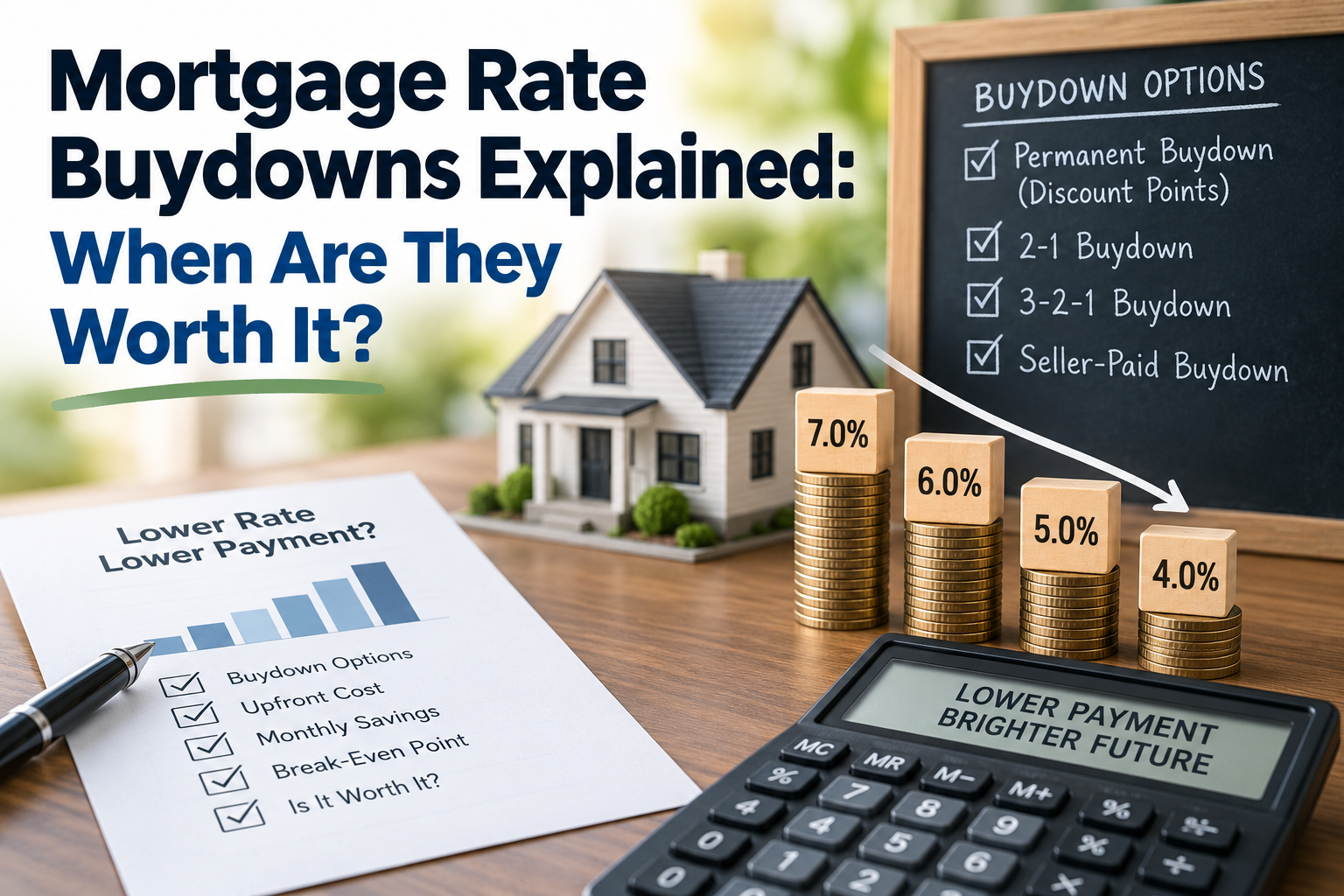
Mortgage Rate Buydowns Explained: When Are They Worth It?
By Learning Real Estate Investing | Updated September 2026
Mortgage rates are high, and the monthly payment on the house you want is uncomfortable.
Then your lender, builder, or real estate agent mentions a mortgage rate buydown.
It sounds simple.
Pay some money upfront and get a lower mortgage rate.
But there is an important question:
Is the lower payment actually worth what the buydown costs?
Sometimes it is.
Other times, keeping the cash or negotiating a lower home price may be the better move.
The key is understanding what type of buydown you are being offered and running the numbers before you agree.
Quick Answer
A mortgage rate buydown lowers your mortgage payment by reducing the interest rate you pay.
There are two main types:
- Permanent buydown: You pay discount points to lower the interest rate for the life of the loan.
- Temporary buydown: Your payment is reduced for the first one, two, or three years before rising to the full payment.
A permanent buydown is usually worth considering when you expect to keep the mortgage long enough for the monthly savings to recover the upfront cost. A seller-paid temporary buydown can also be attractive because it can reduce your early payments without requiring you to pay the entire cost yourself.
In This Guide
What Is a Mortgage Rate Buydown?
A mortgage rate buydown is a way to reduce the interest rate or payment on a mortgage.
Someone pays money upfront to create that benefit.
That money might come from:
- The buyer
- The seller
- A home builder
- The lender
- Another permitted party to the transaction
However, not every buydown works the same way.
This is where buyers need to pay attention.
There are two very different strategies:
Permanent buydown: Your actual mortgage interest rate is reduced.
Temporary buydown: Your payment is reduced for a limited period, but the loan still has a higher permanent note rate.
Permanent Mortgage Buydowns: How Discount Points Work
A permanent buydown usually involves paying discount points.
You pay more money at closing.
In return, the lender gives you a lower interest rate.
One discount point equals 1% of the mortgage amount.
For example, suppose your mortgage is $300,000.
One point would cost:
$300,000 × 1% = $3,000
Paying $3,000 does not automatically mean your rate will fall by one percentage point.
That is important.
The amount your rate drops depends on the lender, loan type, and mortgage market.
Therefore, always ask for the exact rate with and without points.
Example: Paying Points to Lower the Rate
Suppose you have a $315,000 mortgage.
Your lender gives you two options.
| Option | Rate | Upfront Points | Approx. P&I |
|---|---|---|---|
| No Buydown | 6.71% | $0 | $2,035 |
| Illustrative Buydown | 6.21% | Varies | About $1,931 |
In this example, the lower rate saves about $104 per month in principal and interest.
But that monthly savings does not tell you whether the points are worth buying.
You still need to calculate the break-even point.
The example above is for education only. The relationship between points and interest rates varies by lender and market. Taxes, insurance, HOA fees, and mortgage insurance are not included.
What Is a Temporary Mortgage Buydown?
A temporary buydown works differently.
Your actual mortgage has a permanent note rate.
However, money is set aside to reduce your required payment during the first few years.
Common examples include:
- 1-0 buydown
- 2-1 buydown
- 3-2-1 buydown
The numbers tell you how much the effective payment rate is reduced each year.
How Does a 2-1 Mortgage Buydown Work?
A 2-1 buydown typically lowers the payment as if the rate were two percentage points lower during the first year.
During the second year, the payment is calculated as if the rate were one percentage point lower.
In year three, the borrower begins making the full payment based on the note rate.
Let’s use a $315,000 mortgage with a 6.71% note rate.
| Period | Payment Based On | Approx. P&I Payment |
|---|---|---|
| Year 1 | 4.71% | $1,636 |
| Year 2 | 5.71% | $1,830 |
| Year 3 and Later | 6.71% | $2,035 |
During the first year, the payment is about $399 lower per month.
During the second year, it is about $205 lower.
After that, the payment rises to the full amount.
The approximate amount needed to fund those payment reductions in this example is about $7,243.
That money does not magically disappear.
Someone has to fund the temporary buydown.
Do not miss this:
With a temporary buydown, you should be prepared for the full payment when the buydown ends. Do not buy the house based only on the lower first-year payment.
What About a 3-2-1 Buydown?
A 3-2-1 buydown follows the same basic idea.
The payment starts even lower and then rises each year.
For example, with a 6.71% note rate:
- Year 1 may be based on 3.71%.
- Year 2 may be based on 4.71%.
- Year 3 may be based on 5.71%.
- Year 4 begins the full 6.71% payment.
Loan-program rules matter.
For example, Fannie Mae permits qualifying temporary buydowns on certain eligible mortgages with a buydown period of no more than three years and annual payment-rate increases within its guidelines.
Your lender should confirm what is permitted for your specific loan.
Permanent vs. Temporary Buydown
| Feature | Permanent Buydown | Temporary Buydown |
|---|---|---|
| Lower rate | For life of loan | Temporary payment benefit |
| Upfront funding | Usually discount points | Funds cover early payment difference |
| Payment later increases? | Not because the buydown ends | Yes |
| Best for | Longer-term borrowers | Reducing early payments |
| Main question | Will I reach break-even? | Can I afford the full later payment? |
How to Calculate the Break-Even Point on Mortgage Points
This is one of the most important calculations.
Suppose buying points costs you $4,000.
The lower rate saves you $100 per month.
The calculation is:
$4,000 ÷ $100 = 40 Months
Your break-even point is about 40 months.
That is three years and four months.
If you sell or refinance before then, you may not recover the upfront cost through monthly savings.
If you keep the mortgage much longer than 40 months, the buydown may become more attractive.
Simple formula:
Cost of points ÷ monthly payment savings = approximate break-even period.
When Is a Mortgage Rate Buydown Worth It?
A buydown can make sense in several situations.
You Plan to Keep the Mortgage for a Long Time
This is especially important for permanent discount points.
The longer you keep the lower rate, the more time you have to recover the upfront cost.
The Seller Is Paying for the Buydown
This can change the decision.
If the seller is offering a concession anyway, using part of it to reduce your rate or early payments may help your cash flow.
Still, compare that option with other uses for the seller credit.
You Have Plenty of Cash After Closing
Paying points may be reasonable if doing so does not drain your emergency savings.
Do not save $100 per month on your mortgage while leaving yourself with no money for repairs.
The Break-Even Period Is Short
A shorter break-even period makes a permanent buydown easier to justify.
For example, breaking even in two years may be more attractive than waiting eight years.
The Lower Payment Gives You Useful Breathing Room
A temporary seller-funded buydown can make the first years of homeownership easier.
That could help while you rebuild savings after closing.
However, you still need to be able to afford the full future payment.
When Is a Mortgage Buydown Probably Not Worth It?
You Expect to Sell Soon
If you will sell before reaching the break-even point, paying permanent discount points may not make financial sense.
You Expect to Refinance Soon
The same issue applies.
If you refinance, the old mortgage goes away.
The points you paid on that loan do not transfer to the new mortgage.
The Buydown Uses Most of Your Savings
Cash has value too.
After buying a house, you may need money for:
- Repairs
- Moving
- Furniture
- Appliances
- Emergencies
A slightly lower mortgage payment is not worth leaving yourself financially exposed.
You Are Using a Temporary Buydown to Afford an Unaffordable House
This is a major red flag.
If the first-year payment works but the full payment does not, the house may be too expensive.
The temporary buydown does not fix that problem.
It delays it.
Should You Ask the Seller for a Rate Buydown?
It can be worth considering.
This is especially true when a seller is motivated.
Imagine the seller is willing to give you a $10,000 concession.
You might use that money toward:
- Closing costs
- A permanent mortgage-rate buydown
- A temporary buydown
- Other eligible expenses
Do not automatically choose the buydown.
Ask your lender to show you several options.
Then compare them side by side.
A Better Way to Compare Seller Concessions
Ask for these scenarios:
1. No buydown
2. Permanent rate buydown
3. Temporary 2-1 buydown
4. Seller pays more closing costs instead
5. Lower purchase price, if negotiable
Would a Lower Purchase Price Be Better?
Sometimes.
Buyers often focus only on lowering the rate.
But a lower purchase price can also have long-term value.
For example, a lower price may:
- Reduce the amount you borrow
- Reduce your down payment
- Lower some closing costs
- Reduce your loan balance from day one
The best choice depends on the numbers.
Ask your lender and real estate professional to help you compare the options.
Are High Mortgage Rates Making You Question Whether to Buy?
A lower rate can help, but the complete purchase still needs to fit your budget.
Read: Should You Buy a House When Mortgage Rates Are High? →
Questions to Ask Before Paying for a Mortgage Buydown
☐ What is my interest rate without the buydown?
☐ What will my rate be after paying points?
☐ Exactly how much will the points cost?
☐ How much will I save each month?
☐ What is my break-even point?
☐ Who is paying for the buydown?
☐ Is this a permanent or temporary buydown?
☐ What will my payment be after a temporary buydown ends?
☐ Would using the money for closing costs be better?
☐ Would negotiating the purchase price be better?
☐ What happens if I refinance early?
☐ How much savings will I still have after closing?
The Biggest Mistake Buyers Make With Buydowns
The biggest mistake is focusing only on the first payment.
A temporary buydown can make a mortgage look much cheaper.
But the permanent payment still matters.
Before closing, look at the payment you will eventually owe.
Include:
- Principal
- Interest
- Property taxes
- Homeowners insurance
- Mortgage insurance
- HOA fees
Then make sure that payment works within your budget.
The safest approach:
Treat the temporary payment reduction as a bonus. Make your buying decision based on whether you can afford the full payment.
Know Your Real Monthly Payment
Taxes, insurance, mortgage insurance, and HOA fees can make your payment much higher than a basic calculator suggests.
Frequently Asked Questions
What is a mortgage rate buydown?
A mortgage rate buydown uses money paid upfront to reduce the borrower’s interest rate or temporarily reduce the borrower’s payment.
How much does one mortgage point cost?
One discount point equals 1% of the mortgage amount. On a $300,000 mortgage, one point equals $3,000.
Does one point lower my mortgage rate by 1%?
No. The rate reduction for each point varies by lender, loan program, and market conditions.
What is a 2-1 mortgage buydown?
A 2-1 temporary buydown typically reduces the payment as if the interest rate were two percentage points lower during year one and one percentage point lower during year two. The borrower then makes the full payment based on the note rate.
Who pays for a 2-1 buydown?
The funds may come from a permitted seller, builder, lender, or other source depending on the loan program and transaction. Ask your lender which funding sources are allowed.
Is buying mortgage points worth it?
It can be. Compare the upfront cost with the monthly savings. Then calculate how long you need to keep the mortgage to reach your break-even point.
What happens to discount points if I refinance?
Refinancing replaces your old mortgage with a new one. Therefore, you should consider the possibility of refinancing when deciding whether paying points today makes financial sense.
Should I take a seller-paid 2-1 buydown?
It can be valuable, especially if the seller is paying the cost. However, compare it with other seller concessions and make sure you can comfortably afford the full mortgage payment after the buydown ends.
Learning Real Estate Investing Resource Center
Can You Really Afford the House?
Learn how income, debt, taxes, insurance, savings, and the mortgage payment affect your real buying budget.
Buying When Rates Are High
Learn when buying today may still make sense and when waiting could be smarter.
Free Real Estate Investing Chapter
Build your real estate knowledge before putting your money at risk.
Final Thoughts
So, are mortgage rate buydowns worth it?
Sometimes.
But do not judge a buydown simply by how much it lowers your first mortgage payment.
Look at what it costs.
Look at how much you save.
Calculate your break-even point.
Think about how long you expect to keep the mortgage.
And if you are considering a temporary buydown, make sure you can afford the full payment when the temporary savings disappear.
Most importantly, compare your choices.
A buydown is only one way to improve a home purchase.
A lower price, seller-paid closing costs, a larger down payment, or simply keeping more cash in savings may be better.
The best mortgage deal is not always the one with the lowest advertised rate. It is the one that gives you the strongest overall financial position.
LEARN BEFORE YOU BUY
Start With the Free Real Estate Investing Chapter
Learn how to understand real estate opportunities, analyze the numbers, and make smarter property decisions.
Educational Disclaimer: This article is for educational and informational purposes only. It is not mortgage, financial, investment, tax, or legal advice. Loan programs, interest rates, seller-contribution rules, and mortgage qualification requirements vary. Speak with qualified mortgage and financial professionals before making a home purchase or financing decision.