
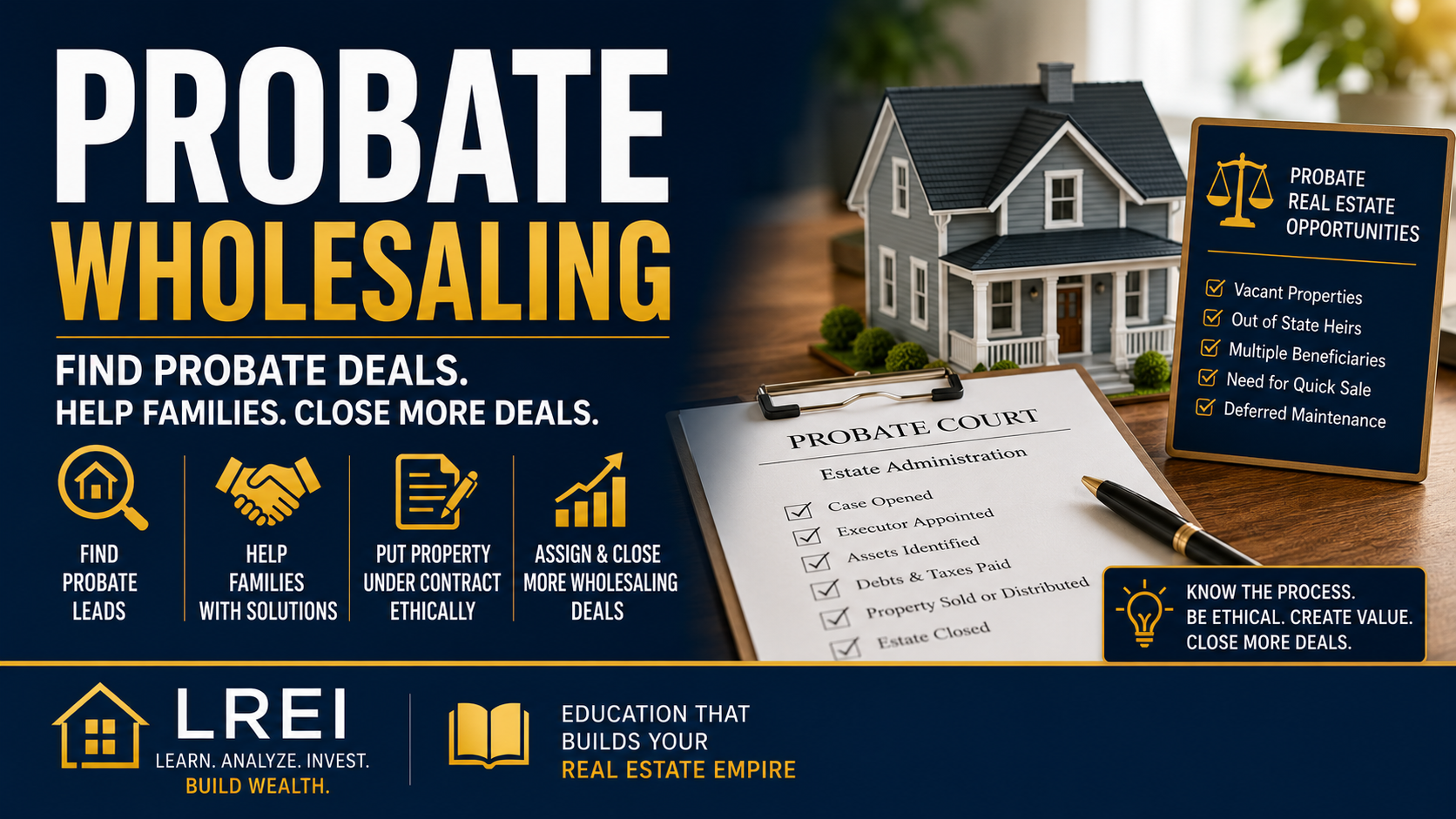
Probate Wholesaling: A Beginner’s Guide to Finding Probate Real Estate Deals
Quick Answer
Probate wholesaling is a real estate investing strategy that focuses on properties owned by an estate after someone dies. An investor may locate a probate property, negotiate with the legally authorized estate representative, place the property under contract, and assign the contractual interest to another investor when permitted. Because probate involves legal procedures and families dealing with a loss, investors should verify authority to sell, understand local probate requirements, and approach every seller respectfully.
Key Takeaways
- Probate wholesaling focuses on real estate owned by estates.
- Not every inherited property must go through probate.
- Verify who has legal authority to sell before signing a contract.
- Probate procedures vary by state and sometimes by the specific estate.
- Probate leads may come from court records, referrals, attorneys, and other sources.
- Communicate with families respectfully and avoid high-pressure tactics.
- Analyze every property before making an offer.
Table of Contents
Probate wholesaling can give real estate investors access to properties that may never appear through ordinary seller marketing channels. Some heirs and estate representatives want to keep inherited real estate, while others would rather sell because maintaining an additional property creates expenses, repairs, taxes, insurance, and management responsibilities.
That does not mean every probate case is a distressed-property opportunity. The investor’s job is to determine whether a sale makes sense for the estate and whether the property makes financial sense as an investment.
Approach probate as a problem-solving niche, not a distress-hunting niche. A professional investor should provide clarity, convenience, and a legitimate option—not pressure someone because they recently lost a family member.
What Is Probate Wholesaling?
Probate is a court-supervised legal process that may be used to administer a deceased person’s estate.
Depending on the estate, state law, estate-planning documents, and how property was titled, real estate may become part of the probate estate.
A probate wholesaler typically:
- Locates a potential probate property.
- Identifies the estate and appropriate representative.
- Determines whether the representative has authority to sell.
- Evaluates the property.
- Negotiates a purchase agreement.
- Completes due diligence.
- Assigns the contract to an end buyer when legally permitted or uses another appropriate closing structure.
The probate process and the wholesale transaction are separate issues. First verify that the estate can legally sell the property. Then determine whether the deal works as an investment.
How Does the Probate Process Work?
The exact process varies, but a probate administration may involve several basic stages.
| Stage | What May Happen |
|---|---|
| Case Opened | A probate petition or similar filing begins the court process. |
| Representative Appointed | An executor, administrator, or other personal representative may be formally authorized. |
| Assets Identified | Estate property, financial accounts, and other assets are identified. |
| Claims Addressed | Valid debts, taxes, and estate obligations may need to be handled. |
| Property Sold or Distributed | Real estate may be sold or distributed according to the estate documents and applicable law. |
| Estate Closed | Remaining assets are distributed and the administration is completed. |
Some estates are simple. Others involve contested wills, multiple beneficiaries, liens, title problems, unpaid taxes, or court approval requirements.
A willing heir does not automatically mean the property can be sold immediately. You need to know who holds title and who has legal authority to execute the sale.
Why Probate Properties Can Create Investment Opportunities
Inherited real estate may create responsibilities that beneficiaries did not expect or do not want.
Common situations include:
- A vacant house generating monthly expenses
- An older property requiring repairs
- Out-of-state heirs
- Multiple beneficiaries who would prefer cash
- Property taxes and insurance
- Cleaning and personal-property removal
- An unwanted rental property
- Deferred maintenance
An investor may be able to provide a simpler sale by purchasing the property as-is and working with the estate’s timeline.
That convenience has value—but only if the estate actually wants that type of solution.
How to Find Probate Leads
Probate lead generation requires research and consistency.
Probate Court Records
Probate filings may be publicly accessible depending on the jurisdiction. Investors may research newly opened estates and determine whether real estate is involved.
Probate Attorneys
Relationships with attorneys can be valuable because attorneys regularly work with estate representatives who must address real property.
Estate Sale Companies
Estate sale professionals may encounter families preparing inherited properties for sale.
Real Estate Agents
Agents sometimes encounter probate situations that are not appropriate for a traditional listing or need a cash buyer.
Referral Relationships
Title companies, investors, contractors, senior-transition professionals, estate planners, and other local professionals may become referral sources when appropriate.
Probate Lead Services
Some companies compile probate-related records into prospecting lists. Verify the accuracy of the data and make sure your intended use complies with applicable laws.
Build a referral network alongside your direct marketing. A trusted relationship with a probate attorney or estate professional may produce fewer leads than a large purchased list—but the referrals may be substantially warmer.
Need More Motivated Seller Leads?
Explore the LREI real estate lead-generation resources and build a more consistent pipeline of potential investment opportunities.
How to Contact Probate Sellers Respectfully
Probate communication requires more sensitivity than a typical cold sales pitch.
You may be reaching someone who:
- Recently lost a parent or spouse
- Is overwhelmed by estate administration
- Lives far from the property
- Is dealing with family disagreements
- Does not yet know what they want to do
Start with questions instead of assumptions.
Conversation Starters
- “Would now be an okay time to talk about the property?”
- “Have you decided what you’d like to do with the house?”
- “What would make handling the property easier for you?”
- “Is there a particular timeline you’re working with?”
If the seller is not ready, do not force the conversation.
Do not open a probate conversation by telling the family that you know someone died and you want to buy the house cheaply. That approach is insensitive, damages trust, and can destroy your reputation.
How to Analyze a Probate Wholesale Deal
Once the estate is legitimately interested in selling, evaluate the property just as carefully as any other wholesale opportunity.
Review:
- After Repair Value (ARV)
- Property condition
- Repair costs
- Mortgage payoff
- Tax liens
- Other title issues
- Closing costs
- Holding costs
- End buyer profit requirement
- Your potential wholesale fee
- Maximum Allowable Offer (MAO)
Analyze the Property Before Making Your Offer
Use the LREI investment-property analysis resources to estimate ARV, repairs, profit potential, and your maximum allowable offer before putting a probate property under contract.
Who Has Authority to Sell Probate Property?
This is one of the most important questions in probate wholesaling.
Depending on the estate and jurisdiction, authority might belong to:
- An executor named in a will and formally authorized
- A court-appointed administrator
- A personal representative
- A trustee if the property is actually owned by a trust rather than the probate estate
- Heirs or beneficiaries after title has legally transferred to them
Do not guess.
Work with a qualified title company, closing attorney, probate attorney, or other appropriate professional to verify ownership and signing authority.
The person answering your phone call may be the family member managing everything informally but still lack authority to execute a binding real estate contract. Verify before moving forward.
What if There Are Multiple Heirs?
Multiple beneficiaries can make a transaction more complicated.
They may disagree about:
- Whether to sell
- What price to accept
- Whether to repair the property
- Whether to list with an agent
- How quickly the property should be sold
The investor should not attempt to provide legal advice or resolve family disputes.
Instead, allow the estate’s attorney and authorized representative to handle legal and beneficiary issues.
Common Probate Wholesaling Mistakes
Assuming Every Probate Property Is Distressed
Some inherited homes are fully renovated and worth listing at retail.
Contacting the Wrong Person
Verify the estate representative instead of assuming any family member can sell.
Ignoring Court Requirements
Some transactions may require additional approvals or procedures.
Using High-Pressure Marketing
Families may need time before they are ready to make a decision.
Failing to Check Title
Inherited properties may have mortgages, liens, judgments, taxes, or other title issues.
Overpaying
A motivated estate does not automatically make the property a good investment.
Failing to Build Your Buyers List
If your plan is to assign the contract, identify potential buyers before the closing deadline becomes a problem.
Probate leads can take longer to mature than ordinary motivated-seller leads. Some families will not be ready for weeks or months. Patient follow-up is part of the strategy.
Probate Wholesaling Checklist
- ✅ Verify the probate case.
- ✅ Identify the correct property.
- ✅ Identify the authorized representative.
- ✅ Confirm authority to sell.
- ✅ Understand any required court procedures.
- ✅ Communicate respectfully with the family.
- ✅ Inspect the property.
- ✅ Estimate repairs.
- ✅ Calculate ARV.
- ✅ Check title, liens, and taxes.
- ✅ Determine your maximum offer.
- ✅ Build your cash buyers list.
- ✅ Use appropriate contracts.
- ✅ Follow up professionally.
Probate law is primarily governed at the state level. For general information about probate and estate administration, review the Cornell Legal Information Institute probate overview and your state’s official court or judiciary resources.
This article is educational and is not legal advice. Consult a qualified attorney about the rules governing a particular estate or transaction.
What Type of Real Estate Investor Are You?
Take the FREE investor quiz to discover which strategy best matches your goals, capital, schedule, and risk tolerance.
Real Estate Investing Resource Center
Use these resources to generate probate leads, analyze properties, and build your wholesaling business.
📈 Real Estate Lead Generation
Explore resources designed to help investors build a stronger motivated seller pipeline.
🏠 Flipster
Explore tools designed around finding off-market properties and organizing investor leads.
📊 Analyze Investment Property
Run the numbers before making an offer on an inherited property.
🛠️ Rehab Valuator Premium
Analyze rehab-heavy wholesale, flip, and BRRRR opportunities.
🚀 30-Day Challenge
Turn your real estate education into consistent daily action.
📘 The Real Estate Investing Blueprint
Learn the fundamentals of finding leads, analyzing deals, communicating with sellers, and building your investing business.
Frequently Asked Questions
What is probate wholesaling?
Probate wholesaling involves locating real estate connected to an estate, negotiating a purchase agreement with the legally authorized seller, and assigning the contractual interest to another investor when permitted.
Is probate wholesaling legal?
Wholesaling and probate transactions are subject to state real estate, contract, probate, licensing, and disclosure laws. The transaction must be structured appropriately for the jurisdiction and estate.
Can an heir sell a probate property?
Not automatically. Authority depends on how the property is titled, the status of the estate, court orders, estate documents, and applicable state law.
How do investors find probate leads?
Common sources include court records where available, probate attorneys, referrals, estate sale companies, real estate professionals, direct marketing, and probate lead providers.
How long does probate take?
There is no universal timeline. A straightforward estate may move relatively quickly, while complicated or disputed estates can take substantially longer.
Do probate houses always sell below market value?
No. Many inherited properties sell at or near retail market value. A property only becomes an investment opportunity when the seller’s needs and the property’s economics create a workable transaction.
Learn How to Find Off-Market Deals and Analyze Them With Confidence
Download the FREE chapter of The Real Estate Investing Blueprint and learn how to generate leads, communicate with sellers, analyze properties, and build your real estate investing foundation.