
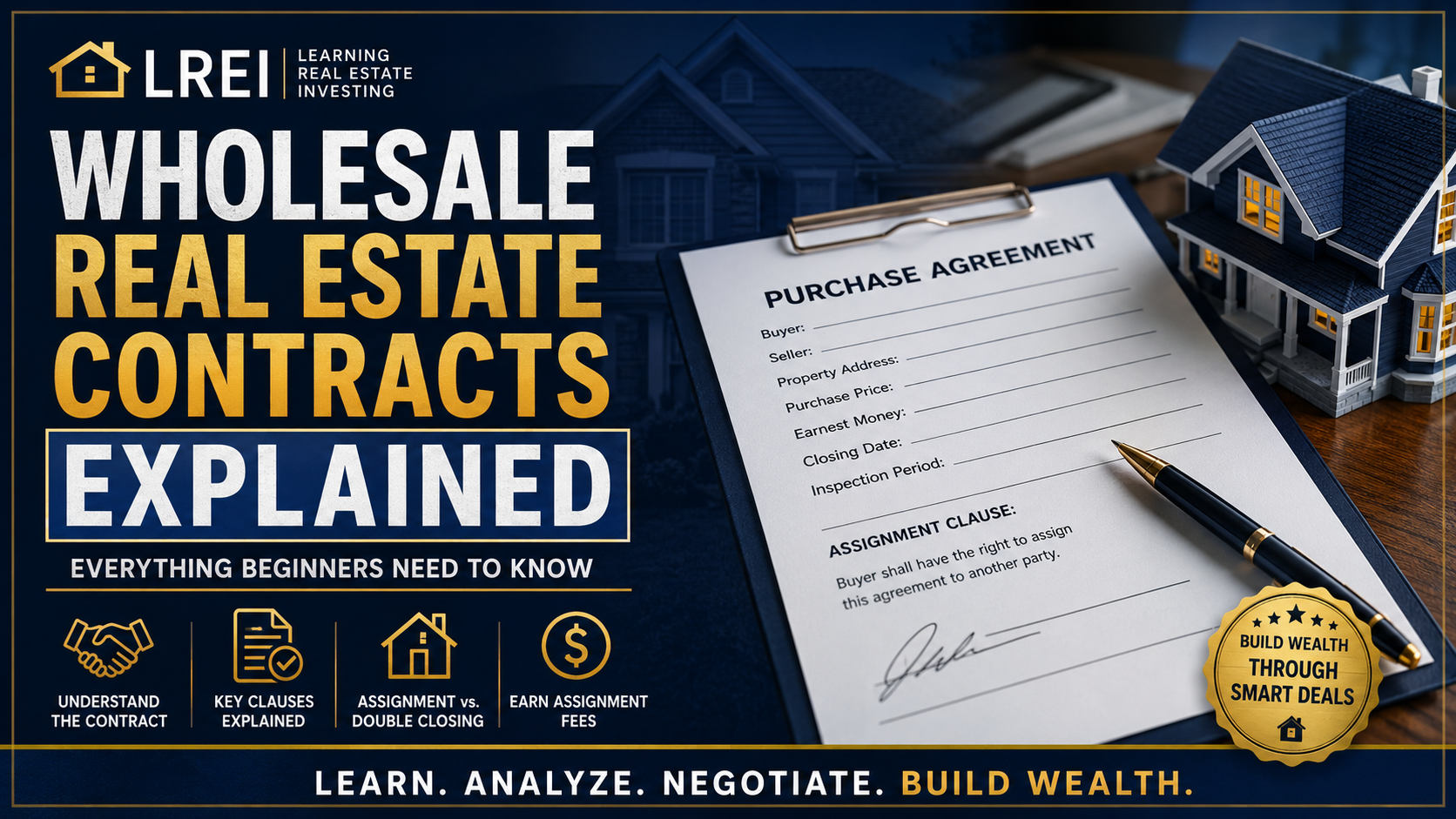
Wholesale Real Estate Contracts Explained: Everything Beginners Need to Know
Quick Answer
A wholesale real estate contract is a legally binding agreement between a seller and a buyer that allows the buyer to purchase a property under specific terms. In many wholesale transactions, the wholesaler later assigns their contractual rights to another investor for an assignment fee. Understanding the contract, deadlines, assignment language, and local laws is essential before attempting a wholesale deal.
Key Takeaways
- Wholesale real estate starts with a valid purchase agreement.
- The contract controls your rights, deadlines, and responsibilities.
- Many wholesalers exit through an assignment or double closing.
- Assignment rules and licensing requirements vary by state.
- Never use a contract you do not understand.
- Have a qualified local real estate attorney review your documents.
Table of Contents
What Is a Wholesale Real Estate Contract?
A wholesale real estate contract is typically a purchase and sale agreement between a property owner and a wholesaler.
The wholesaler negotiates the right to purchase the property at an agreed-upon price and under specific terms.
Instead of keeping the property, the wholesaler may assign those contractual rights to another investor when the agreement and applicable law allow it.
The difference between what the seller agrees to accept and what the end buyer is willing to pay can create the wholesaler’s assignment fee.
In wholesaling, the contract is often the asset. Your value comes from finding an opportunity, negotiating favorable terms, and connecting the deal with a qualified buyer.
How Wholesale Real Estate Contracts Work
A typical wholesale transaction follows a simple sequence.
- Find a motivated property owner.
- Analyze the property and determine your maximum offer.
- Negotiate terms with the seller.
- Sign a purchase agreement.
- Complete your due diligence.
- Find a qualified end buyer.
- Assign the contract or complete another approved closing structure.
- Close through a title company or attorney, depending on local practice.
The key is creating enough room in the deal for the end buyer to make a profit after repairs, holding costs, financing, resale expenses, and your wholesale fee.
Analyze the Deal Before You Put It Under Contract
Use the LREI Deal Analyzer to estimate ARV, repairs, profit, ROI, and your maximum allowable offer before making an offer.
Assignment Contract vs. Double Closing
Wholesalers generally use one of two common exit strategies.
| Method | How It Works | Main Advantage | Main Consideration |
|---|---|---|---|
| Assignment | The wholesaler transfers contractual rights to the end buyer. | Usually simpler and lower cost. | The assignment must be permitted by the contract and local law. |
| Double Closing | The wholesaler purchases the property and then resells it to the end buyer. | Can provide more transaction privacy. | Usually involves additional closing costs and may require funding. |
Assignments are popular with beginners because the wholesaler generally does not need to purchase the property first. Double closings may be useful in situations where assignment is impractical or where transaction structure requires it.
Important Sections of a Wholesale Real Estate Contract
Buyer and Seller Information
The agreement should clearly identify everyone involved in the transaction.
Property Description
The contract should correctly identify the property being purchased. Depending on the transaction, this may include the property address and legal description.
Purchase Price
The agreed purchase price must be clearly stated.
Earnest Money Deposit
Earnest money demonstrates that the buyer intends to proceed under the contract.
The amount varies by transaction and market.
Inspection or Due-Diligence Period
This period gives you time to evaluate the property, estimate repairs, verify title issues, review numbers, and determine whether the deal still makes sense.
Closing Date
Your agreement should clearly specify when closing is expected.
Assignment Language
If your plan is to assign the contract, the agreement should be reviewed to determine whether assignment is permitted.
Have a qualified real estate attorney in your state review the contract before you use it. Wholesale laws, required disclosures, licensing requirements, and assignment rules are not identical everywhere.
How Does a Wholesale Assignment Fee Work?
Assume you negotiate a property under contract for $120,000.
After reviewing the deal, another investor agrees to take over your contractual position for a total price of $130,000.
The difference is potentially:
| Item | Amount |
|---|---|
| Seller Contract Price | $120,000 |
| End Buyer’s Price | $130,000 |
| Potential Assignment Fee | $10,000 |
The exact mechanics depend on the transaction, contract documents, closing agent, and local laws.
Do not choose your assignment fee first and force the numbers to work. Start with the property’s actual value, repairs, buyer costs, and required investor profit. Your fee must fit inside a legitimate deal.
What Happens After the Contract Is Assigned?
Once an assignment agreement is properly executed, the end buyer generally assumes the contractual position that was assigned.
The title company or closing attorney then processes the transaction according to the contract documents.
At closing, funds are distributed according to the approved settlement documents.
This is why working with a closing professional familiar with investor transactions is important.
Common Wholesale Contract Mistakes
Using Random Contracts From the Internet
A generic form may not comply with your state’s law or reflect the structure of your transaction.
Ignoring Contract Deadlines
Inspection, financing, earnest money, and closing deadlines matter.
Putting Properties Under Contract Without Analyzing Them
A signed contract does not automatically create a good deal.
Promising Sellers Something You Cannot Deliver
Be clear about your intentions and realistic about your ability to perform.
Failing to Understand Assignment Restrictions
Some agreements restrict or prohibit assignment.
Never sign a contract because someone online said it was “wholesaler friendly.” If you do not understand every major clause, stop and get professional guidance before signing.
Wholesaling is not simply finding a property and collecting a fee. You are participating in a legal real estate transaction involving contracts, deadlines, disclosures, money, and other people’s property.
Wholesale Contract Checklist
- ✅ Verify the seller has authority to sell the property.
- ✅ Confirm the correct property information.
- ✅ Clearly state the purchase price.
- ✅ Understand the earnest money requirements.
- ✅ Review inspection and due-diligence deadlines.
- ✅ Confirm the closing date.
- ✅ Review assignment language.
- ✅ Analyze ARV and repairs.
- ✅ Verify your exit strategy.
- ✅ Use a qualified title company or closing attorney.
- ✅ Have a local attorney review your forms and process.
What Type of Real Estate Investor Are You?
Take the FREE investor quiz to discover which strategy best matches your goals, capital, available time, and risk tolerance.
Real Estate Investing Resource Center
Use these resources to learn the process, analyze deals, and build your wholesaling business.
📘 The Real Estate Investing Blueprint
Learn wholesaling, flipping, rentals, BRRRR, financing, and deal analysis.
📊 LREI Deal Analyzer
Analyze ARV, repairs, ROI, cash flow, and maximum allowable offer.
📈 LREI Deal Analyzer 3.0
Use the advanced deal analyzer for wholesale, flip, rental, and BRRRR opportunities.
🚀 100K Blueprint
Create a focused plan for growing your real estate investing business.
🏘️ Flipster
Explore a platform designed to help investors locate off-market opportunities.
💬 LREI Action Lab
Access investor motivation, real estate quotes, and useful calculators.
Frequently Asked Questions
Is a wholesale real estate contract legally binding?
A properly executed purchase agreement is generally legally binding. The exact rights and obligations depend on the agreement and applicable law.
Can every purchase contract be assigned?
No. Some contracts restrict or prohibit assignment. Review the agreement and applicable state law before relying on an assignment strategy.
Do wholesalers need a real estate license?
Requirements vary by state and by the activities performed. Some jurisdictions regulate wholesaling more heavily than others, so verify current local requirements.
How much earnest money should a wholesaler use?
There is no universal amount. Earnest money is negotiated between the parties and may vary based on the property, market, and agreement.
What is an assignment fee?
An assignment fee is compensation paid to the wholesaler for transferring contractual rights to another buyer when the assignment is legally permitted.
Should beginners use contracts downloaded online?
Be cautious. A generic contract may not reflect your local law or transaction. Have your documents reviewed by a qualified real estate attorney.
Ready to Learn How Wholesaling Really Works?
Download the FREE chapter of The Real Estate Investing Blueprint and learn how to find opportunities, analyze deals, negotiate with sellers, and build your real estate investing foundation.