
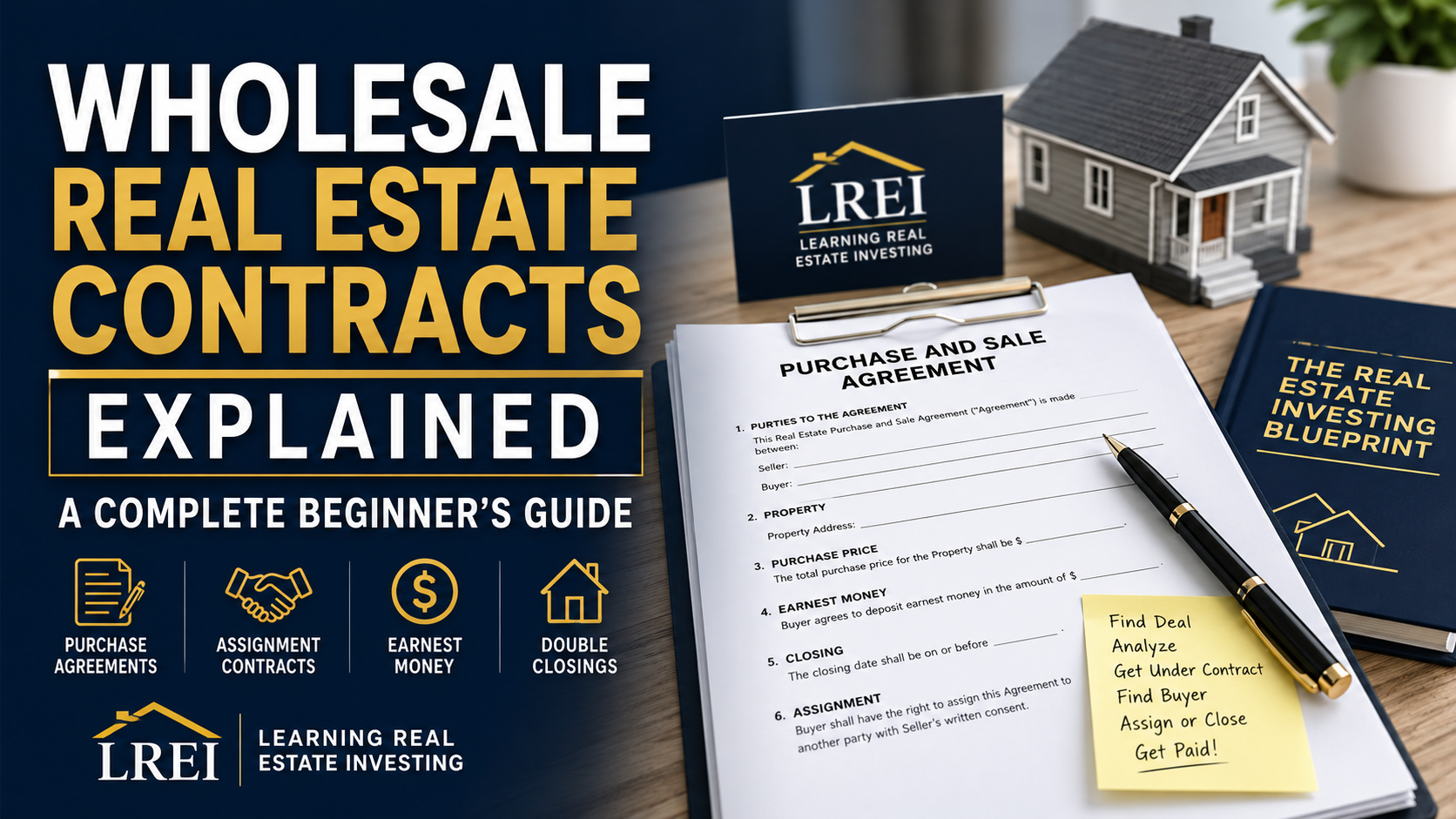
Wholesale Real Estate Contracts Explained: A Complete Beginner’s Guide
Quick Answer
A wholesale real estate contract is a legally binding purchase agreement between a property seller and an investor. The investor places the property under contract at an agreed price and may assign their contractual rights to another buyer for a fee when the agreement and local law allow it. The wholesaler is generally transferring an interest in the contract—not selling a property they own.
Key Takeaways
- A wholesale deal normally begins with a signed purchase agreement.
- The contract must clearly state the price, earnest money, closing date, inspection rights, and responsibilities of each party.
- An assignment agreement transfers the wholesaler’s contractual rights to an end buyer.
- A double closing involves two separate property purchases instead of a contract assignment.
- Contract language and wholesaling laws vary by state.
- Have your forms reviewed by a local real estate attorney before using them.
Table of Contents
What Is a Wholesale Real Estate Contract?
A wholesale real estate contract is an agreement that gives an investor the right and obligation to purchase a property under specific terms. The agreement is usually a purchase and sale contract signed by the property owner and the wholesaler.
After the contract is signed, the wholesaler may search for another investor who wants to purchase the property. When assignment is permitted, the wholesaler can transfer their position in the contract to that investor in exchange for an assignment fee.
The wholesaler does not automatically become the property owner simply because a purchase contract has been signed. Legal ownership normally transfers at closing when the deed is delivered and recorded.
A wholesaler should clearly understand the difference between owning a property and holding contractual rights to purchase it. That distinction affects advertising, disclosures, negotiations, and legal compliance.
How Wholesale Real Estate Contracts Work
The contract is the foundation of the wholesale transaction. It defines what the seller has agreed to accept, what the buyer must do, and when the transaction must close.
A typical wholesale deal follows this process:
- Find a motivated property owner.
- Estimate the property’s current value, after-repair value, and repair costs.
- Negotiate a purchase price that leaves room for an end buyer’s profit.
- Sign a purchase and sale agreement with the seller.
- Deliver the required earnest money to the proper closing professional.
- Open title and complete the inspection and due-diligence process.
- Locate a qualified cash buyer.
- Assign the contract or complete another lawful closing strategy.
- Collect the assignment fee or closing profit.
A contract should never be treated like a free reservation. Once signed, it creates obligations. Investors should understand the numbers and their responsibilities before putting a property under contract.
The contract does not create the profit. The purchase price, repair estimate, resale value, and end-buyer demand create the profit. A well-written contract cannot rescue a bad deal.
The Main Documents Used in a Wholesale Deal
Most wholesale transactions involve at least two major documents: the original purchase agreement and the assignment agreement. Additional addenda and disclosures may also be required.
| Document | Purpose | Parties Involved |
|---|---|---|
| Purchase and Sale Agreement | Establishes the price, closing date, earnest money, contingencies, and responsibilities of the original buyer and seller. | Seller and wholesaler |
| Assignment Agreement | Transfers the wholesaler’s rights and obligations under the purchase agreement to the end buyer. | Wholesaler and end buyer |
| Contract Addendum | Adds, removes, or changes specific terms in the original agreement. | Buyer and seller |
| Property Disclosure | Provides required information about the property or the wholesaler’s contractual interest. | Varies by state and transaction |
| Closing Statement | Shows the purchase price, fees, credits, expenses, and distribution of funds. | Closing parties |
Learn How to Analyze Wholesale Deals
Use the LREI Deal Analyzer to estimate your maximum offer, assignment fee, repair costs, and potential buyer profit before signing a contract.
Important Clauses in a Wholesale Real Estate Contract
A wholesale contract should clearly explain the agreement between the buyer and seller. Vague or missing terms can create disputes, missed deadlines, or financial losses.
Buyer and Seller Information
The contract should list the correct legal names of the parties. When an LLC is purchasing the property, the company name should match its official registration records.
Property Description
The agreement should include the property address and any additional identifying information required in the state, such as the legal description or parcel number.
Purchase Price
The purchase price must be clearly stated. Any seller credits, financing arrangements, unpaid taxes, or other negotiated terms should also be documented.
Earnest Money
Earnest money is a good-faith deposit delivered after the contract is signed. The agreement should state the amount, delivery deadline, and conditions under which the deposit is refundable or nonrefundable.
Inspection Period
The inspection or due-diligence period gives the buyer time to evaluate the property, confirm repairs, examine title issues, and determine whether the deal remains acceptable.
Closing Date
The closing date establishes the deadline for completing the sale. Wholesalers need enough time to conduct due diligence, clear title, locate an end buyer, and coordinate the closing.
Assignment Rights
The agreement should clearly state whether the buyer may assign the contract. Some contracts permit assignment, while others prohibit it or require the seller’s written consent.
Before using any purchase agreement, ask a local real estate attorney to explain the assignment, inspection, default, termination, access, and earnest-money provisions.
How an Assignment of Contract Works
An assignment agreement transfers the original buyer’s contractual position to another buyer. The wholesaler is known as the assignor, and the end buyer is known as the assignee.
The end buyer normally agrees to complete the original purchase and pay the wholesaler an assignment fee. The seller receives the purchase price stated in the original agreement, while the wholesaler’s fee is handled according to the assignment and closing documents.
For example:
- Original purchase contract: $120,000
- Assignment fee: $10,000
- End buyer’s total acquisition price: $130,000, excluding separate closing costs
The end buyer must still have enough room to cover repairs, holding costs, financing, selling expenses, and a reasonable profit. A deal that only pays the wholesaler but leaves nothing for the buyer will be difficult to sell.
Do not assume that writing “and/or assigns” beside your name automatically solves every assignment issue. The complete contract and applicable state law determine whether the agreement may be assigned.
Assignment Versus Double Closing
An assignment is not the only way to complete a wholesale transaction. Some investors use a double closing, also called an A-to-B and B-to-C closing.
In a double closing, the wholesaler purchases the property from the original seller and then sells it to the end buyer in a separate transaction. The wholesaler temporarily takes ownership and may need transactional funding to complete the first purchase.
| Factor | Contract Assignment | Double Closing |
|---|---|---|
| Property ownership | Wholesaler generally does not take title | Wholesaler takes title before reselling |
| Number of closings | One property closing | Two separate property closings |
| Funding needed | Usually lower | Usually higher |
| Closing costs | Generally lower | Generally higher |
| Assignment fee visibility | The fee may appear in assignment or closing documents | Profit is created through the difference between two sales |
| Complexity | Usually simpler | More moving parts and coordination |
A double closing may be considered when assignment is prohibited, the spread is unusually large, or the title company and parties prefer two separate transactions. However, it should not be used simply to hide information improperly.
Build a Stronger Wholesaling Foundation
Learn how contracts, motivated sellers, deal analysis, buyers, and closing strategies work together inside The Real Estate Investing Blueprint.
Common Wholesale Contract Mistakes
Most contract problems are preventable. Beginners often make mistakes because they rush to secure a deal before fully understanding the agreement.
- Using a generic online contract: A form written for another state may not protect you or comply with local law.
- Missing the earnest-money deadline: Failing to deliver the deposit on time may place the buyer in default.
- Ignoring assignment restrictions: Some agreements prohibit assignments or require seller approval.
- Using unrealistic property values: Inflated after-repair values make a weak deal appear profitable.
- Underestimating repairs: Missing foundation, roof, plumbing, electrical, or structural problems can destroy the deal.
- Failing to open title quickly: Liens, probate issues, judgments, and ownership disputes take time to resolve.
- Marketing the property as the owner: Wholesalers should accurately describe the contractual interest they possess.
- Signing without a real exit plan: A buyer should be prepared to perform or exercise a legitimate contractual right.
- Promising guaranteed results: Buyers, sellers, lenders, title issues, and inspections can all affect closing.
- Failing to document changes: Verbal changes should be placed in a written amendment signed by the appropriate parties.
A large assignment fee does not matter until the transaction closes. Protect the deal by using accurate numbers, qualified buyers, clear communication, and legally reviewed documents.
Are Wholesale Real Estate Contracts Legal?
Real estate purchase contracts and assignments are commonly used legal tools, but wholesaling rules differ by state. The way a wholesaler advertises, negotiates, discloses compensation, and represents their interest may determine whether the activity is lawful.
Some states require specific wholesaling disclosures. Others may require registration or a real estate license in certain circumstances. Marketing a property that you do not own can create brokerage or consumer-protection issues when the transaction is not handled correctly.
Wholesalers should clearly disclose their role, avoid misleading advertising, follow contract deadlines, and work with experienced closing professionals.
Build relationships with a wholesaler-friendly title company, closing attorney, and real estate attorney before you place your first property under contract.
Wholesale Contract Review Checklist
- ✅ Correct legal names of buyer and seller
- ✅ Complete property address and legal description
- ✅ Agreed purchase price
- ✅ Earnest-money amount and deadline
- ✅ Inspection and due-diligence period
- ✅ Clear closing date
- ✅ Assignment rights confirmed
- ✅ Property-access terms
- ✅ Title and lien requirements
- ✅ Default and termination provisions
- ✅ Required wholesaling disclosures
- ✅ Attorney review completed
What Type of Real Estate Investor Are You?
Take the free quiz to discover the strategy that best matches your goals, available time, capital, and risk tolerance.
Real Estate Investing Resource Center
📘 The Real Estate Investing Blueprint
Learn wholesaling, flipping, rentals, BRRRR, creative financing, and deal analysis.
📊 LREI Deal Analyzer
Run the numbers before making an offer or signing a purchase agreement.
🏠 Wholesaling Blueprint
Learn how to find motivated sellers, estimate offers, build a buyer list, and complete wholesale transactions.
🎯 Real Estate Investing Quiz
Discover which investing strategy may fit your goals, experience, available cash, and schedule.
Frequently Asked Questions
Can every real estate contract be assigned?
No. Some contracts prohibit assignment, require the seller’s consent, or contain other restrictions. Review the complete contract before assuming it can be assigned.
How much earnest money does a wholesaler need?
There is no universal amount. Earnest money is negotiable and depends on the seller, market, contract, and local customs. Even a small deposit must be delivered by the stated deadline.
Does a wholesaler own the property after signing the contract?
Generally, no. The wholesaler has contractual rights and obligations. Ownership normally transfers only when the transaction closes and the deed is delivered.
Can the seller see the assignment fee?
The assignment fee may appear in the assignment agreement or closing documents. Disclosure requirements and closing practices vary by state and transaction.
Can a wholesaler cancel the contract?
A wholesaler may cancel only when the contract or applicable law provides a valid right to terminate and the required notice is delivered correctly and on time.
What happens if the end buyer backs out?
The answer depends on the assignment agreement and original purchase contract. The wholesaler may remain responsible for closing unless the documents provide another lawful option.
Can wholesalers advertise properties online?
Wholesalers must comply with state advertising and licensing laws. They should accurately market the contractual interest they possess and should not falsely represent themselves as the property owner or listing agent.
Should a beginner write their own wholesale contract?
No. Real estate contracts create serious legal and financial obligations. Use documents prepared or reviewed by an attorney familiar with local wholesaling laws.
Learn Wholesaling Before You Sign Your First Contract
Download the free chapter of The Real Estate Investing Blueprint and learn how to find opportunities, analyze deals, make stronger offers, and build a practical path toward your first real estate transaction.